From Content Channel to Business Moat: How Newsletters Become Strategic Assets
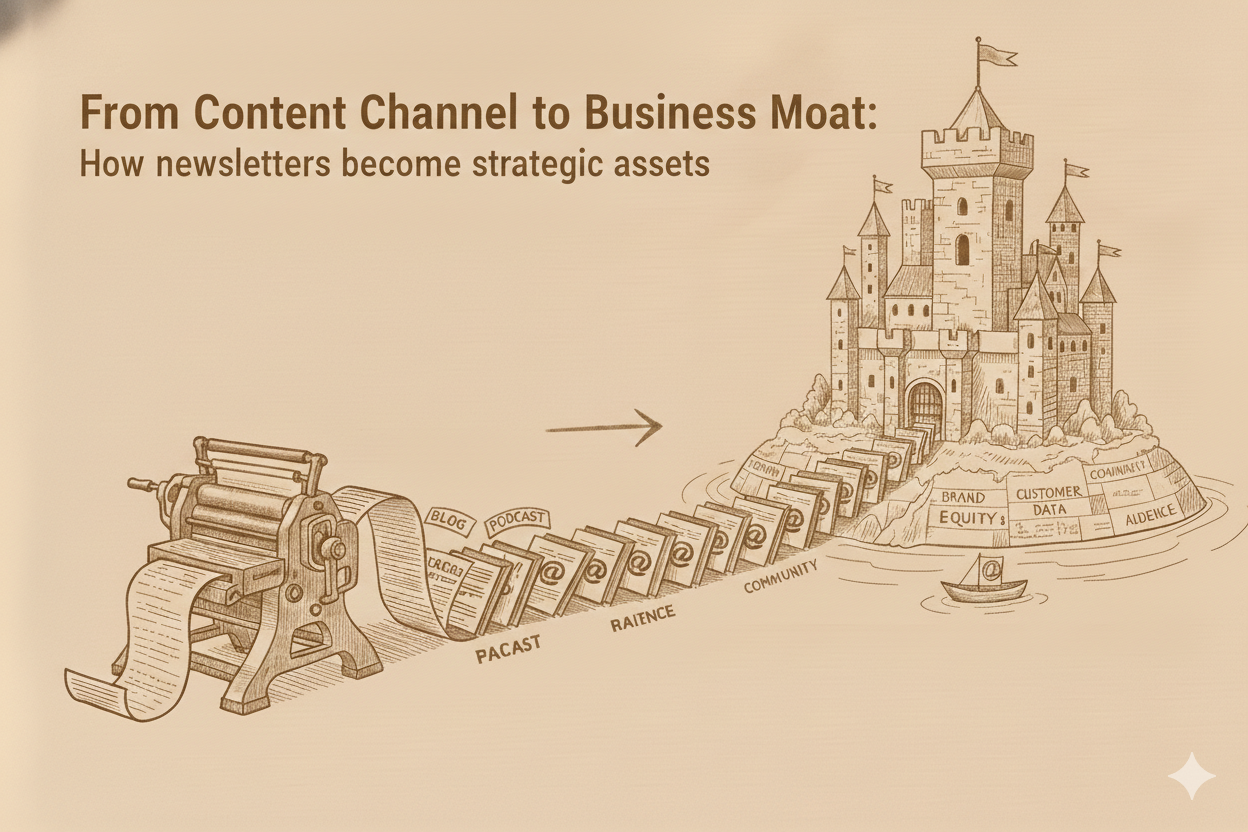
Most founders think of newsletters as marketing channels, a way to promote a product, post updates, or chase vanity metrics. That's short-term thinking. A newsletter, when treated as strategic infrastructure, becomes a business moat: a durable, compounding asset that protects and grows your company over time.
Email isn't just a tool for promotion, it's a platform you own. Unlike social media, search, or paid ads, email gives you direct access to your audience. It's a place where trust compounds, relationships deepen, and influence converts into tangible business outcomes. In short, a newsletter can evolve from a simple content channel into an unassailable strategic advantage.
Why Email Is More Than Marketing
Founders often underestimate the role of email as infrastructure. They focus on metrics like open rates, click-throughs, or subscriber count, treating newsletters as marketing campaigns rather than owned channels of influence.
Here's the problem: marketing channels are rented. Social media platforms can change algorithms overnight. Paid ads can spike in cost. Organic reach can collapse. Metrics that seem healthy today can vanish tomorrow.
Email, by contrast, is an asset you control. Your newsletter isn't subject to a platform's whims. Each subscriber represents a real connection you own, and every message you send strengthens that connection. That ownership is the foundation for a durable business moat.
How Newsletters Compound Value
A newsletter as an infrastructure asset grows in value over time. The more consistently you publish, the stronger your audience relationship becomes. Trust accumulates, engagement deepens, and influence compounds.
Here's how the compounding works:
-
First touch: Your audience discovers your expertise through a newsletter signup.
-
Repeated value: Weekly or biweekly issues build familiarity, credibility, and trust.
-
Action: Subscribers respond to calls to action, whether that's purchasing a product, joining a beta, or sharing your content.
-
Network effect: Engaged subscribers share your newsletter with peers, bringing in higher-quality leads organically.
Unlike social media, where reach decays and algorithms dictate visibility, your newsletter's value grows predictably. Each issue increases audience loyalty, repeat engagement, and influence, all of which translate into measurable business outcomes.
Strategic value of a newsletter at each stage
Value score by subscriber milestone and publishing tenure.
The moat does not form from having a newsletter. It forms from the relationship capital that accumulates over years of showing up.
Ways newsletters create defensible business advantages
% of newsletter founders who cite each moat type after 2+ years.
The Newsletter as Strategic Infrastructure
Treating a newsletter as infrastructure means designing it for durability, not virality. It's not just about chasing opens or clicks, it's about building a system that:
-
Captures attention consistently: Subscribers expect your content on a schedule. Consistency breeds trust.
-
Strengthens relationships: The goal is to be memorable, helpful, and authoritative. Every interaction reinforces your value.
-
Supports decision-making: Your newsletter becomes a tool your audience uses to understand your perspective, products, or services.
-
Provides leverage: When you launch new products, partnerships, or ideas, your audience is ready and responsive.
Infrastructure isn't flashy. It doesn't rely on virality. It's durable, reliable, and compounding. And for founders, that makes it a moat against competition and platform risk.
Turning a Newsletter Into a Business Moat
To transform a newsletter from a marketing channel into a strategic asset, founders must think beyond immediate results. Here's the process:
-
Prioritize owned growth: Every subscriber should be acquired through channels you control like your website, product, or direct referrals, not rented platforms. Your newsletter audience matters more than followers.
-
Deliver strategic value: Every issue should educate, inform, or inspire action. Your audience should gain insight they can't get elsewhere.
-
Build trust through authenticity: Show your thinking, experiments, and reasoning. Transparency builds credibility faster than polished marketing.
-
Integrate with business outcomes: Align your newsletter content with product launches, partnerships, or strategic initiatives. The goal is not just engagement, it's measurable impact.
-
Measure beyond vanity metrics: Track engagement, responses, conversions, and network effects, not just opens or clicks. Metrics that reflect influence and trust matter more than reach alone.
When executed correctly, your newsletter becomes a hub of influence, a platform that generates leads, informs strategy, and protects your business from external shocks. That's how it evolves from content to moat.
Real Advantages
Founders who treat newsletters as strategic infrastructure gain tangible advantages:
-
Resilience to platform risk: You aren't beholden to Instagram, LinkedIn, or TikTok algorithms. Your audience is yours. This is the core lesson of newsletter vs. social growth.
-
Predictable engagement: Compounding trust ensures your launches, updates, and offers land effectively.
-
Amplified influence: Your voice reaches an engaged, receptive audience that can amplify your ideas.
-
Revenue leverage: Email allows founders to ethically monetize without eroding trust. Subscribers become customers, advocates, and referrers.
-
Strategic flexibility: You can pivot messaging, test new products, or explore new business models with an audience that already values your perspective.
Action Steps for Founders
-
Audit your existing channels: Identify where you "own" your audience versus where you're renting attention.
-
Commit to regular cadence: Weekly or biweekly newsletters outperform sporadic, ad-hoc publishing.
-
Design for value, not virality: Focus on delivering insights, frameworks, and perspectives your audience can't get elsewhere.
-
Track influence metrics: Opens, clicks, replies, and referrals matter more than raw subscriber count.
-
Integrate newsletter into your business strategy: Use it to support launches, partnerships, and thought leadership.
Q&A
How is a newsletter different from other content channels? Unlike social media or ads, email is owned, direct, and reliable. Your newsletter doesn't decay due to algorithm changes, making it a durable strategic asset.
How many subscribers do I need before it becomes a moat? Quality matters more than quantity. An engaged core of even a few thousand can deliver significant leverage if trust and influence are high.
Can a newsletter replace social media entirely? Not necessarily. Social is great for discovery, but your newsletter is the hub, the compounding infrastructure where your influence truly grows.
A newsletter isn't just marketing, it's infrastructure. Every founder who treats email as a strategic asset builds a durable business moat, converting attention into trust, trust into influence, and influence into measurable business outcomes. If you want a channel that compounds in value while others fade under algorithmic volatility, start treating your newsletter like the asset it truly is.
Framework Summary
- Content channel → strategic asset: A newsletter becomes a business moat when treated as owned infrastructure, not a promotional broadcast.
- Compounding value loop: First touch (signup) → repeated value (weekly issues) → action (conversion) → network effect (reader shares bring in qualified leads).
- The five-step moat-building process: (1) Prioritize owned subscriber acquisition, (2) deliver strategic value every issue, (3) build trust through authenticity and transparency, (4) integrate content with business outcomes, (5) measure engagement and conversions — not vanity metrics.
- Platform resilience: Unlike social or paid channels, a newsletter audience is unaffected by algorithm changes, ad cost spikes, or platform policy shifts.
- Durability over virality: Infrastructure doesn't need to go viral — it compounds quietly, protecting against competition and platform dependency.
Written by

Investor • Founder • Creator
Ryan Estes is co-founder of Kitcaster, an eight-figure bootstrapped podcast booking agency acquired by Moburst in 2025. He created AI for Founders, a podcast, newsletter, and workshop platform reaching 47,000+ entrepreneurs and CEOs. Based in Denver, Colorado.