Newsletter Growth vs Social Growth: Why Email Compounds While Algorithms Collapse
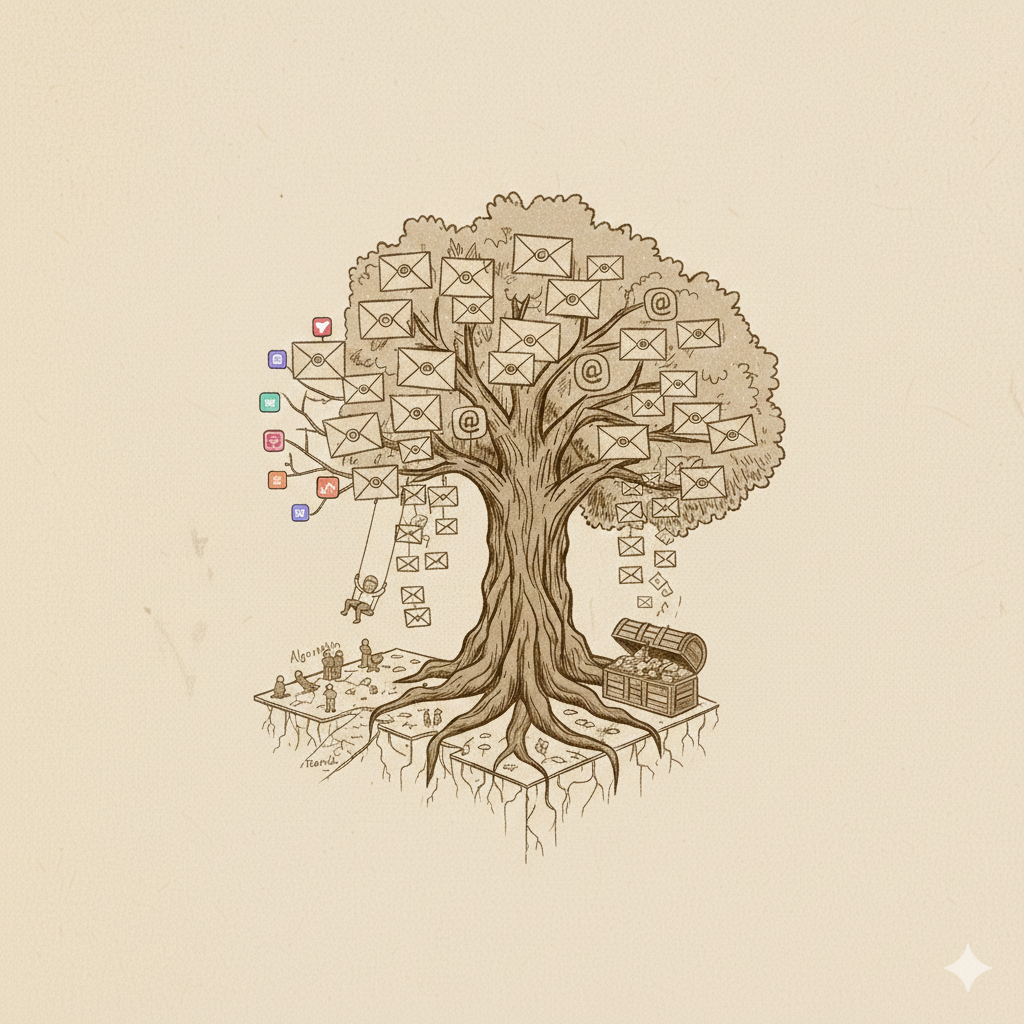
If you spend enough time around founders, you hear the same admission, usually said quietly and with mild embarrassment:
"I know I should focus on email… but I keep getting pulled back into the algorithm."
It's understandable. Social platforms are loud, addictive, and engineered to keep you engaged. They manufacture momentum, reward consistency, and drip-feed validation right up until they don't.
Email, by contrast, is slow. Intentional. Unflashy. There is no late-night spike of virality or dopamine-fueled feedback loop. But it does something social platforms almost never do over time:
It compounds.
For founders who need durable distribution, predictable access to customers, and channels they can rely on through market cycles, compounding beats virality every time.
This post breaks down the structural reasons email behaves like an asset while social behaves like a slot machine, why algorithms inevitably collapse, why newsletters quietly become engines, and how to shift your strategy toward distribution you actually own.
The Myth of "Building an Audience" on Social
Social platforms promise audience-building. The fine print tells a different story:
- You don't own the audience
- You don't control the reach
- You don't set the rules
- Everything can change overnight
Founders understand leverage. Distribution is leverage. On social, however, distribution is not owned, it is rented from platforms whose incentives are fundamentally misaligned with yours.
Here's why social growth is structurally fragile.
1. Algorithms protect the platform, not the creator
As your content gains traction, it competes with the platform's core objective: maximizing session time across millions of users. When any single creator captures too much attention, the algorithm quietly rebalances.
What feels like an unexplained engagement drop is often just the system correcting in its own favor. This is similar to the measurement problems we see with email metrics,except with social, the obfuscation is baked into the business model.
2. Reach fluctuates even when quality doesn't
- Monday: you go viral
- Tuesday: 14 likes
- Wednesday: you wonder if you're shadowbanned
It's not personal. It's mathematical.
Feeds are zero-sum environments. Every post competes against ads, trending topics, influencers, paid placements, and the platform's own content. Founders need predictability. Social offers volatility.
3. Distribution can vanish overnight
Ask anyone who built on:
- Organic Facebook Pages in 2012
- Instagram reach in 2018
- TikTok before geopolitical uncertainty
- Twitter before its many algorithmic "rebalances"
Your audience lives inside a walled garden. When the landlord changes the rules, access disappears.
This is the core flaw of social-first businesses:
You're building a skyscraper on rented land.
Email Works Because It's an Asset Class, Not an Algorithm
Founder-led newsletters win for one simple reason:
Email is protocol-based, not platform-based.
Protocols don't manipulate incentives. They don't suppress reach to sell ads. They do exactly one thing reliably:
Deliver your message.
Here's why email compounds.
1. Every subscriber increases guaranteed distribution
If your list has 5,000 subscribers, you have 5,000 guaranteed sends. If it grows to 50,000, so does your distribution.
Not estimated impressions. Not algorithmic reach with volatility.
Actual delivery.
Even with typical open rates, the curve remains stable and forecastable unlike social, where a following of 100,000 can yield a few thousand views or a few hundred depending on the day.
Subscribers create a linear, durable distribution asset.
2. Email growth compounds through reinforcement loops
Every strong newsletter triggers three reinforcing effects:
- Existing readers stay engaged
- Some readers forward or recommend
- New readers join and strengthen the base
Each send increases the probability of future growth. One issue feeds the next. Momentum accumulates, social produces spikes, and email produces loops.
One is episodic. The other is cumulative.
3. A list increases the value of everything you build
Your list is distribution. Distribution is oxygen.
Every product, feature, event, or launch becomes cheaper, faster, and more profitable when you can communicate directly with your audience. This is exactly why turning your newsletter into a revenue engine is one of the highest-leverage activities a founder can pursue.
This is why:
- Newsletters sell for six and seven figures
- Private equity firms value lists as assets
- Founder-led businesses scale faster with owned distribution
Try selling your Instagram following. Try exporting your LinkedIn audience.
You can't, because you never owned them.
Organic reach rate by platform
% of your followers/subscribers who see each piece of content.
Social reach figures reflect typical non-viral organic performance. Email reach is deterministic. You pay for what you send.
Revenue per 1,000 followers / subscribers
Estimated annual direct revenue, excluding virality outliers.
Founders Don't Need More Followers. They Need Distribution
Founders are not influencers. The goal is not likes but leverage.
- Social is a discovery channel
- Email is a relationship channel
You need both, but businesses grow on email.
Social-only founders must feed the algorithm daily. When it changes, momentum collapses.
Founders who build email engines operate differently. Their distribution compounds quietly, independent of platform whims.
Why Algorithms Collapse (and Always Will)
The lesson most creators learn eventually:
Algorithms always regress to the mean.
Over time:
- Platforms saturate
- Competition intensifies
- Organic reach declines
- Paid placement takes priority
- Feeds become crowded
- Growth is throttled to preserve session time
What once worked stops working.
This is not a bug. It's the business model.
Algorithms exist to optimize platform growth, not yours. Once you see this clearly, the strategic conclusion becomes unavoidable:
Convert attention into distribution.
Email is the only channel whose incentives do not collapse under their own weight.
Platform dependency risk: what changes when the algo shifts
| Platform event | Reach impact | Revenue impact | Recovery time |
|---|---|---|---|
| Email: ESP pricing change | None | Cost +10–20% | Immediate (migrate) |
| Instagram algorithm update (2022) | −60% reach | −40–70% revenue | 6–12 months |
| LinkedIn feed change (2023) | −30% reach | −20–40% leads | 3–6 months |
| Twitter chaos (2022–23) | −50% engagement | −30–60% revenue | Still recovering |
| Facebook organic collapse (2018) | −80% reach | Pages effectively dead | Never recovered |
Email is the only channel where a platform change cannot zero out your reach overnight.
The Founder Advantage: Build Once, Leverage Forever
Many founders optimize for followers when they should optimize for surface area.
A newsletter creates leverage social never can:
- Posts become long-form thinking
- Emails become social threads
- Essays become products
- Archives become intellectual property
- Distribution attracts partners, hires, and investors
Your newsletter compounds your ideas, credibility, and business.
Social compounds none of these. It resets daily.
The best founders understand a simple truth:
Social makes you visible. Email makes you unavoidable.
If You're a Founder, Here's the Playbook
A durable strategy:
- Use social as top-of-funnel discovery, Short-form content → curiosity → invitation
- Build your newsletter as the core asset, Long-form thinking → trust → distribution
- Launch and scale through your list, Distribution becomes the revenue engine
- Protect your list relentlessly, Backups, segmentation, hygiene, consistency
Social is volatile. Email is anti-fragile.
The noisier the market becomes, the more valuable direct, intentional communication feels.
Choose the Channel That Chooses You Back
Social platforms exist to keep attention inside their walls. Email exists to deliver your message.
Only one respects the relationship between you and your audience.
If you're building long-term leverage, build where you own the rules. Build where attention turns into assets. Build where distribution becomes destiny.
Build your newsletter.
If you're ready to build an email engine that compounds, schedule a call with Inbox Alchemy to discuss how we can help you create durable distribution.
Frequently Asked Questions
Why not focus on social if it's faster early on?
Social is excellent for discovery, but speed without durability creates false momentum. Email converts early attention into long-term leverage. If you're getting started with email newsletters, building the habit of list growth early pays dividends for years.
Is email still relevant with modern platforms?
Yes. Precisely because it is not governed by feeds, algorithms, or shifting incentives. Its simplicity is its strength.
How often should founders publish a newsletter?
Consistency matters more than frequency. Weekly or biweekly is sufficient if the content compounds trust and clarity.
Can a small list really matter?
Absolutely. A highly engaged list of 1,000 readers with permission-based access outperforms a disengaged social following of 100,000.
What is the core takeaway?
Social creates visibility. Email creates ownership. Visibility fades; ownership compounds.
If you are a founder, the decision is simple: build on channels that grow with you,not ones that quietly pull the floor out from under you.
Framework Summary
- Social growth is structurally fragile: Algorithms protect the platform, not the creator; reach fluctuates regardless of content quality; distribution can vanish overnight when platform incentives shift.
- Email compounds because it is protocol-based: Every subscriber is a guaranteed send — not an estimated impression — and that number grows linearly and predictably with your list.
- Three email compounding loops: (1) Existing readers stay engaged, (2) some forward or recommend, (3) new readers join and strengthen the base — each send reinforces all three loops simultaneously.
- The ownership comparison: Social audiences live inside walled gardens; email lists are portable, platform-independent assets that appreciate in value with every issue you send.
- Strategic implication for founders: Allocate attention to channels you own; use social as a discovery and conversion funnel into your newsletter, not as the primary relationship layer.
Written by

Investor • Founder • Creator
Ryan Estes is co-founder of Kitcaster, an eight-figure bootstrapped podcast booking agency acquired by Moburst in 2025. He created AI for Founders, a podcast, newsletter, and workshop platform reaching 47,000+ entrepreneurs and CEOs. Based in Denver, Colorado.