Joel Keith / ASP:
How a Trades Operator Built a Newsletter That Converts Before the First Call
The CEO of ASP used a weekly newsletter to establish peer-level credibility with home service contractors, remove the education burden from sales, and build a pipeline that arrives pre-qualified.

Pipeline quality.
Not brand awareness.
Every editorial decision was made in service of one outcome: getting a qualified contractor on a strategy call with Joel, already convinced they are in the right room.
- Position Joel as a credible operator inside the trades world, not another marketing vendor from the outside
- Reach contractors in the $2M to $5M range who have outgrown word of mouth and are ready to break through a growth ceiling
- Move qualified readers toward a free 45-minute Growth Assessment without aggressive pitching inside the content
- Create a recurring content asset that builds a body of work, not just a sequence of individual posts
The partner who tells the truth,
pulls up the data live.
Joel came up through the trades world. He writes from inside the business, because that is where he has spent his career. The brand reflects that entirely.

Operator-First
Not agency-first. Written from inside the field, not from behind a pitch deck.
Blunt with Data
Real figures. Real client stories. No vague promises about visibility or brand equity.
Systems-Oriented
Campaigns are outputs. Systems are the work. The newsletter teaches that distinction repeatedly.
Present in the Field
Mentally there, not just behind a screen. The writing reads like someone who has stood in a contractor's shoes.
Empathy first.
Tactics second.
Sentences are short. Paragraphs break before they drift. Every issue drops the reader into a scene or a pain point in the first three lines. Joel names what the reader is already feeling before offering anything resembling a solution.
“You're invisible” is a Joel sentence. “You may be experiencing some visibility challenges” is not.


Designed for one outcome: a qualified contractor on a strategy call.
The newsletter was structured with every issue closing on a soft call to action for a free 45-minute Growth Assessment. The editorial architecture, recurring CTAs, and content sourcing rules were all built around that single conversion event.
A note on metrics
Specific subscriber counts, open rates, and conversion data are sourced directly from Beehiiv analytics and CRM. What is confirmed here is the editorial design and pipeline architecture that drives those results.
Businesses that have proven
they can generate revenue.
What they can't do is scale it.
The revenue sweet spot is $2M to $5M annually. These are operators who have outgrown word of mouth but have not yet built the systems to get to the next level. That precision means every issue speaks directly to someone, not vaguely to everyone.
- HVAC, roofing, remodeling, plumbing, and electrical contractors
- Business owners who have proven revenue but hit a consistent ceiling
- Operators skeptical of marketing vendors who do not speak their language
- Readers who arrive after six issues pre-educated, pre-qualified, and vocabulary-aligned


By the time they book the call,
they are evaluating timing,
not vendors.
By the time a reader books a Growth Assessment, they have already encountered Joel's frameworks, his data, and his positioning on why most marketing vendors rent visibility rather than build it. The Growth Assessment is the only offer in the content, positioned as a soft postscript, never inside the body.
Readers arrive fluent in Joel's frameworks and already aligned with his diagnosis of their problem. The call confirms, it does not introduce.
The Growth Assessment is the only CTA. Trust is built through content so the offer does not have to work as hard.
Spending decisions are downstream
of destination decisions.
This is not a concept Joel talks about occasionally. It is the operating logic of the newsletter, recurring across issues and building into a coherent body of work. The frameworks are precise enough to be proprietary and practical enough to apply before a contractor ever becomes a client.
Proprietary Frameworks
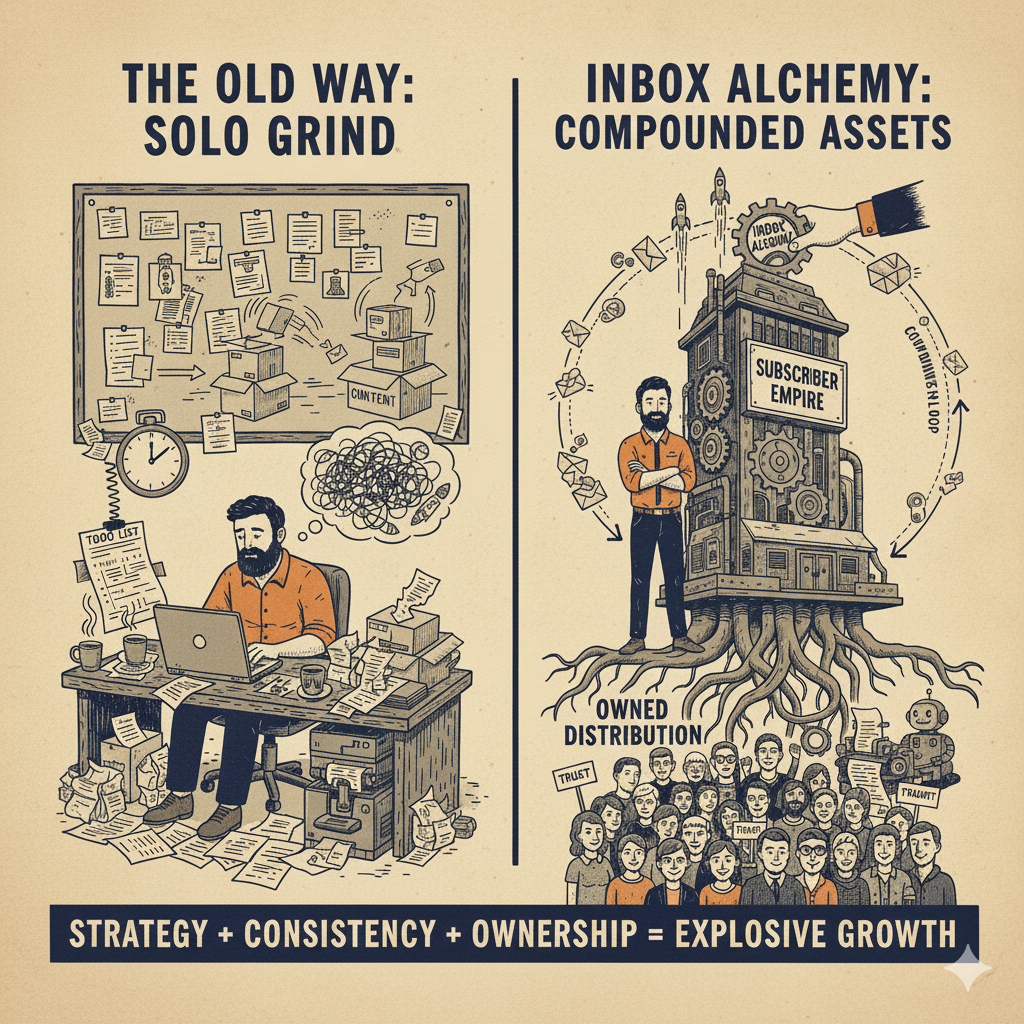
A contractor who reads Joel's content regularly is not a lead in a pipeline. They are a future client who has already decided to trust him.
Joel's content success is not about format or frequency. It is about credibility. He writes from inside the world his readers live in, using the language they use, naming the problems they are too busy to articulate, and offering frameworks they can apply before they ever become a client. The operators who own their audience directly will be the ones who can grow without renting attention they do not control.