The Best Send Times for Newsletter Growth
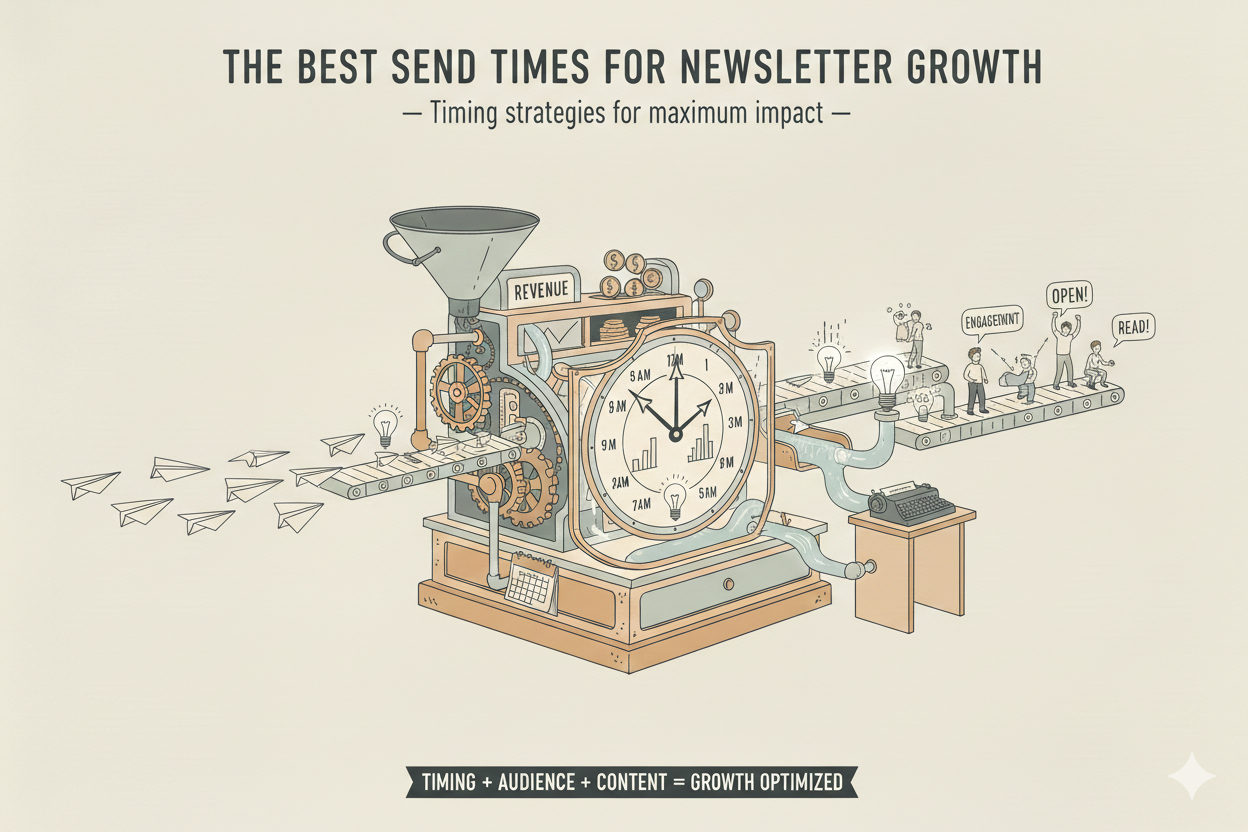
The Best Send Times for Newsletter Growth
Timing psychology that boosts response rates
You want your newsletter to land, so you spend hours crafting the issue, refining the angle, and obsessing over the subject line. You grow your list, hit send, and wait for the response that never comes. Subscribers don't open. Engagement stalls. Some emails go straight to spam. When this happens, most creators assume the problem is the content.
Often, it isn't.
The answer is timing, whether your newsletter is arriving when your reader is actually ready to receive it.
Open rate index by day of week
Index = relative performance vs weekly average (100 = average).
Tuesday–Thursday is the proven window. Weekends struggle because inbox competition spikes and attention dips.
Open rate index by time of day
Assumes sends are in subscriber's local timezone.
"What's the best time to send a newsletter?"
Tuesday at 10am. Thursday at 8am. Sunday evening. Monday afternoon.
The internet is full of charts that promise certainty.
And most of them quietly fail the moment they're applied to a real audience.
Because send time is not a universal rule. It's a psychological moment.
The newsletters that grow fastest are not the ones sent at the "right" hour. They're the ones that arrive when the reader is mentally available to care.
This piece breaks down how timing actually works, why generic benchmarks underperform, and how to engineer send times that increase opens, replies, and long-term loyalty.
Why "best send time" advice usually underperforms
Most send time advice is built on averages.
Averages flatten context.
They ignore:
- Who the reader is
- What they're doing when the email arrives
- Why they subscribed in the first place
- What emotional state the email competes with
A SaaS founder skimming inbox at 6:30am behaves differently than a creator reading on a Sunday afternoon. A marketer between meetings behaves differently than a solo operator working at night.
Send time advice fails because it treats inboxes like clocks instead of environments.
The inbox is not neutral territory. It is a psychological battlefield.
And timing determines whether your email feels like help or interruption.
Optimal send time by audience type
| Audience | Best day | Best time | Why |
|---|---|---|---|
| B2B / founders | Tuesday | 8–10am | Read before meetings start |
| Consumer / lifestyle | Thursday | 6–8pm | Evening wind-down reading |
| Finance / investing | Monday | 7–9am | Market prep mindset |
| Health / wellness | Sunday | 7–9am ✓ | Weekly planning ritual |
| News / media | Daily | 6–8am | Morning briefing habit |
| Creator / marketing | Wednesday | 9–11am | Mid-week strategy time |
These are starting points, not rules. A/B test 2–3 send times over 8 weeks and let your own data decide.
The real variable: attention posture
Before thinking about days or hours, think about attention posture.
Attention posture answers one question: What mental mode is the reader in when your email arrives?
There are three dominant postures that matter for newsletters.
Task mode
The reader is clearing inbox, scanning quickly, making decisions.
Emails in task mode must be immediately legible, low friction, and value-forward. This posture dominates weekday mornings and early afternoons.
Reflective mode
The reader is slower, more open, more curious.
Emails in reflective mode get read deeply, replied to, and remembered. This posture often appears early mornings, evenings, and weekends.
Escape mode
The reader is killing time or avoiding something else.
This posture can generate opens, but shallow engagement. It competes directly with feeds, news, and entertainment.
Growth happens when your newsletter's intent matches the reader's attention posture.
What "growth" actually means for newsletters
Before choosing send times, define growth properly.
Growth is not just opens.
Real newsletter growth looks like:
- Higher reply rates
- Longer read time
- Lower churn
- Stronger word-of-mouth
- Better conversion when offers appear
Optimizing for opens pushes you toward crowded inbox moments. Optimizing for trust pushes you toward quieter ones.
Inbox Alchemy consistently sees the same pattern: The send times with slightly lower opens often produce higher replies and retention.
That tradeoff compounds.
Understanding what metrics truly indicate growth is essential. Learn more about the critical newsletter metrics that matter beyond vanity numbers.
The psychology of weekday sends
Monday: cognitive overload
Monday inboxes are heavy.
Readers are catching up, prioritizing, and deleting aggressively. Monday sends work best when they reduce chaos rather than add to it.
Dense essays and hard asks tend to underperform here.
Tuesday to Thursday: the performance window
Midweek readers are more settled and more responsive.
This is why most benchmarks point here. It's also the most crowded inbox environment of the week.
Winning midweek requires clarity over cleverness. Subject lines must earn attention, not borrow it from timing.
Friday: selective attention
Friday is not dead, it's filtered.
Readers engage with content that feels reflective, light, or perspective-driven. Heavy tactics and urgency struggle.
The underrated power of weekends
Most newsletters avoid weekends.
That's exactly why they work.
Weekend inboxes are quieter. Attention is slower. Competition is lower.
Sunday, in particular, is a reflective day.
Readers are reviewing the week and mentally preparing for what's next. This makes Sunday powerful for founder essays, strategy pieces, and long-term thinking.
Open rates may dip slightly. Reply rates often rise meaningfully.
For growth built on loyalty, weekends are underused leverage.
Morning vs afternoon vs evening
Early morning
This is a private, intentional moment.
Readers who open early choose your email before the day starts. Early morning sends favor insight, calm confidence, and personal voice.
They build parasocial trust quickly.
Midday
This is transactional time.
Readers are efficient and distracted. Midday emails must respect time and deliver value fast.
Great for skimmable or tactical content.
Evening
Evening opens are emotional.
Readers are tired, reflective, or disengaging. Evening sends work best when the tone is human and conversational.
Evenings are poor for urgency. They are excellent for resonance.
Why consistency beats optimization
Many newsletters stall not because of bad timing, but inconsistent timing.
Consistency trains anticipation.
When readers know when to expect you, your email stops feeling like noise and starts feeling like a habit.
Habit is the highest form of inbox trust.
Inbox Alchemy typically recommends:
- One primary send window
- Occasional intentional deviations
- Clear signaling when timing changes
Growth comes from rhythm, not randomness.
If your newsletter feels stuck, the issue might not be timing at all. Explore how to revive a stalled newsletter with fresh strategy.
How to find your best send time without guesswork
Forget benchmarks. Run small experiments.
- Pick two distinct time windows
- Hold everything else constant
- Measure beyond opens: replies, churn, read depth
- Run long enough to spot patterns
Your audience will tell you when they want to hear from you.
You just need to listen to the right signals.
The signal most creators ignore
Replies.
Replies are the clearest indicator of timing alignment.
When timing is right, readers respond emotionally and contextually. When timing is off, emails get skimmed or ignored.
If you want growth through depth, optimize for replies.
This connects directly to unlocking real newsletter engagement, where replies become the foundation of audience connection.
Timing as brand positioning
Your send time sends a message.
Early morning signals intention. Midday signals efficiency. Weekend signals reflection.
There is no neutral timing.
The fastest-growing newsletters choose timing that reinforces their philosophy.
Timing is not logistics. It's brand.
Timing, tailored
At Inbox Alchemy, we focus on finding your voice, understanding your audience, and making sure your timing is right.
There is no universal answer. There is no perfect hour.
There is only the timing crafted specifically for you, your goals, your campaign, and your readers.
When timing aligns with psychology, newsletters stop being opened and start being remembered.
Ready to find your optimal send timing? Book a free consultation with our team.
Frequently Asked Questions
What is the best day to send a newsletter?
There is no universal best day. Midweek often delivers higher opens, while weekends frequently generate deeper engagement and replies. The best day depends on your audience's attention posture and why they subscribed.
Is it better to send newsletters in the morning or evening?
Morning sends favor intention and focus, while evening sends favor reflection and emotional resonance. The right choice depends on your content's tone and desired outcome.
Do send times really affect newsletter growth?
Yes, but indirectly. Timing influences how readers emotionally receive your message. Growth comes from alignment with attention, not from chasing open rate benchmarks.
How often should I test different send times?
Test intentionally, not constantly. Run small experiments over several sends, then commit to a consistent rhythm once patterns emerge.
Should new newsletters prioritize timing or content first?
Content first. Timing amplifies what already works. Strong writing builds trust; timing determines how easily that trust is accessed.
Written by

Investor • Founder • Creator
Ryan Estes is co-founder of Kitcaster, an eight-figure bootstrapped podcast booking agency acquired by Moburst in 2025. He created AI for Founders, a podcast, newsletter, and workshop platform reaching 47,000+ entrepreneurs and CEOs. Based in Denver, Colorado.