From Readers to Relationship: Turning Subscribers Into Conversations
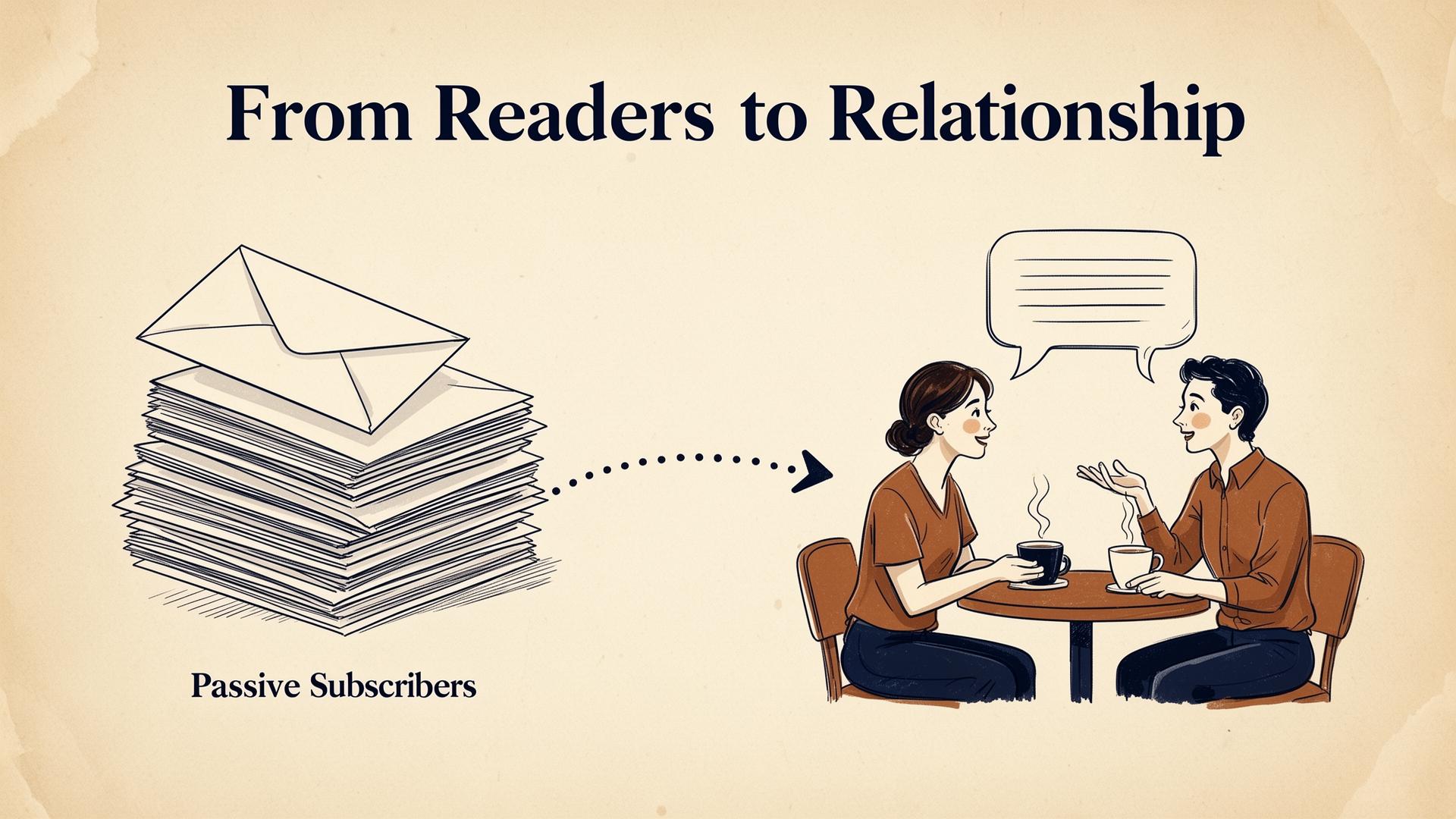
Most founders measure newsletters the wrong way. Open rates. Click rates. List size. These metrics feel tangible but they are distractions if your goal is building a business. Attention is cheap. Conversation is rare.
A subscriber who replies is more valuable than a thousand silent readers. Replies signal trust, intent, and cognitive engagement. They are proof your audience is not just consuming content. They are thinking about it and willing to engage.
If your goal is pipeline, partnerships, and durable brand equity, replies are the real KPI.
This requires a fundamental shift from audience building to relationship architecture. It requires designing your newsletter to invite dialogue rather than applause.
Why Traditional Metrics Fail Founders
Most email platforms like Mailchimp and ConvertKit default to tracking opens, clicks, and subscriber growth because they are easy to measure and compare. This works for publishers but misleads founders. A high open rate does not guarantee influence. Clicks do not guarantee intent. Growth does not guarantee engagement.
Opens measure curiosity. Clicks measure tactical interest. Replies measure relational trust. Only replies correlate directly with long-term business outcomes such as deal flow, strategic insight, and brand authority.
A newsletter designed for replies does something extraordinary. It transforms a broadcast channel into a two-way conversation that compounds value over time. Understanding what metrics actually matter is the first step toward this shift.
How Replies Shift the Economics of Your List
When a subscriber replies, three things happen that change the value of your list.
First, you move from broadcast to dialogue. You are no longer talking at an audience. You are engaging with a peer. Second, you gain qualitative intelligence. Replies reveal objections, ambitions, vocabulary, and timing without surveys or guesswork. Third, inbox algorithms take notice. Platforms like Gmail and Microsoft Outlook interpret replies as meaningful engagement, improving deliverability.
Replies are a compounding asset. They deepen trust, improve inbox placement, sharpen positioning, and surface revenue opportunities. No open or click metric can deliver all of these outcomes. This is why small lists often outperform big ones, depth of engagement beats breadth of reach.
Newsletter tactics that generate replies
Lift in reply rate vs baseline issue with no explicit engagement prompt.
A specific question outperforms a vague invitation every time. 'Hit reply' is not a question. 'What is your biggest challenge with X?' is.
Revenue correlation by engagement depth
Average annual revenue per subscriber segment.
Why Most Newsletters Never Generate Replies
Founders often complain that no one replies to newsletters. Usually, this is a design flaw, not a market truth.
There are three common reasons:
Overpolished Content
If your newsletter reads like a final essay, subscribers feel like spectators. Spectators do not interrupt. If it sounds like a polished TED Talk, it will be treated like one. Learning to make your newsletter feel human is key.
No Conversational Prompt
An ending such as "Let me know what you think" is too vague. It requires readers to invent a reason to reply, and most will not.
Lack of Psychological Safety
If your newsletter signals authority but not approachability, readers hesitate to engage. They do not want to appear uninformed or intrusive. Conversation requires permission.
How to Design a Newsletter That Gets Replies
If replies are the KPI, the structure and tone of your newsletter must change.
Write Like a Person
Effective founder newsletters feel like emails sent from one founder to another. Short paragraphs, strong opinions, and direct questions lower the activation energy required to reply. The brevity and directness provoke reflection and response without overwhelming the reader. This ties directly to finding your newsletter personality type.
Ask Binary or Experience-Based Questions
Instead of asking "What are your thoughts?" frame your prompts around decisions and experiences. For example:
- "Are you hiring before product market fit or after?"
- "Have you ever killed a feature you loved because customers ignored it?"
Binary questions reduce friction. Experience-based questions trigger memory. Memory triggers response.
Reveal Incomplete Thinking
Sharing evolving ideas rather than polished frameworks encourages engagement. When you say, "I am pressure testing this idea," readers feel invited to participate. People reply to influence outcomes, not applaud conclusions. This is how a story-based newsletter framework works in practice.
Respond Thoughtfully and Aggregate Insights
When subscribers reply, respond individually. Reference their input in future newsletters. For example: "Several of you said positioning before Series A is the hardest part." This signals that replies have real impact and builds a feedback loop that further drives engagement.
Replies as a Revenue Signal
For founders, replies are not vanity metrics. They are market intelligence. Patterns to watch:
- Multiple replies asking how you implemented an idea
- Readers sharing their own results
- Inbound requests for introductions or collaborations
Replies indicate higher trust and cognitive bandwidth. Unlike public social media engagement, inbox replies are private and intentional. They reveal willingness to engage deeply. Scarcity implies value. This is how your newsletter becomes a revenue engine.
The Conversation Flywheel
Once replies start arriving, a compounding loop emerges.
You publish insight. Readers reply. You learn from responses. Your next newsletter becomes sharper and more relevant. More readers reply.
Over time, your newsletter transforms from a distribution channel into a strategic intelligence engine. Depth of engagement beats breadth of reach. A small, engaged list will outperform a large, passive audience in influence, insight, and commercial opportunity. This is the compounding effect of newsletters.
Operationalizing Replies as a KPI
Treat replies as a measurable objective rather than an afterthought. Track:
- Reply rate per issue
- Unique repliers over 30 days
- First-time versus repeat responders
- Conversations that convert into calls or meetings
Set realistic benchmarks. For founder newsletters, a one to three percent reply rate can be more valuable than a ten percent click rate. Prioritize responses that signal strategic alignment, urgency, or network leverage. Your inbox becomes a relationship pipeline rather than a vanity dashboard.
Be aware of the engagement measurement problem, standard metrics can be misleading due to bot activity and link scanners. Understanding the difference between real and fake engagement is crucial for making informed decisions.
From Audience to Access
An audience is passive. Access is relational. Replies grant access.
When subscribers consistently respond, you gain position in their mental priority stack. Algorithms fluctuate. Platforms change. Open rates get distorted by privacy updates. A direct, ongoing conversation in a subscriber's inbox remains durable and defensible.
Replies are not just engagement. They are relational capital, attention from a decision-maker, and a signal of trust that is difficult for competitors to replicate. This is why newsletters build trust faster than any other channel.
Q&A
Is asking for replies risky for deliverability?
Encouraging authentic replies improves signals for inbox providers. It is not risky if the prompts are genuine.
What if I receive too many replies to manage?
This is a high-quality problem. Filters, labels, or CRM workflows help categorize and prioritize responses by intent.
Should every issue ask for a reply?
Strategic cadence matters. Use prompts for feedback, validation, or engagement rather than forcing interaction in every email.
Do replies work for B2B founders?
Absolutely. Direct conversations accelerate trust formation, shorten sales cycles, and surface partnership opportunities in high-value markets.
The Strategic Reframe
If you are a Series A founder or venture-backed operator, your newsletter should not be treated like a media property. It should operate as a relationship engine.
Open rates measure visibility. Clicks measure curiosity. Replies measure trust. Trust precedes revenue.
Design for replies. Optimize for dialogue. Build your list not as a distribution channel, but as a network of ongoing conversations.
That is how readers become relationships. That is where leverage lives.
If you want to turn your newsletter into a relationship engine that generates real dialogue and actionable insights, reach out to Inbox Alchemy. We help founders design newsletters that spark replies, deepen trust, and unlock business opportunities.
Written by

Investor • Founder • Creator
Ryan Estes is co-founder of Kitcaster, an eight-figure bootstrapped podcast booking agency acquired by Moburst in 2025. He created AI for Founders, a podcast, newsletter, and workshop platform reaching 47,000+ entrepreneurs and CEOs. Based in Denver, Colorado.