Escape Newsletter Burnout, Sustainable Publishing Rituals for Founders
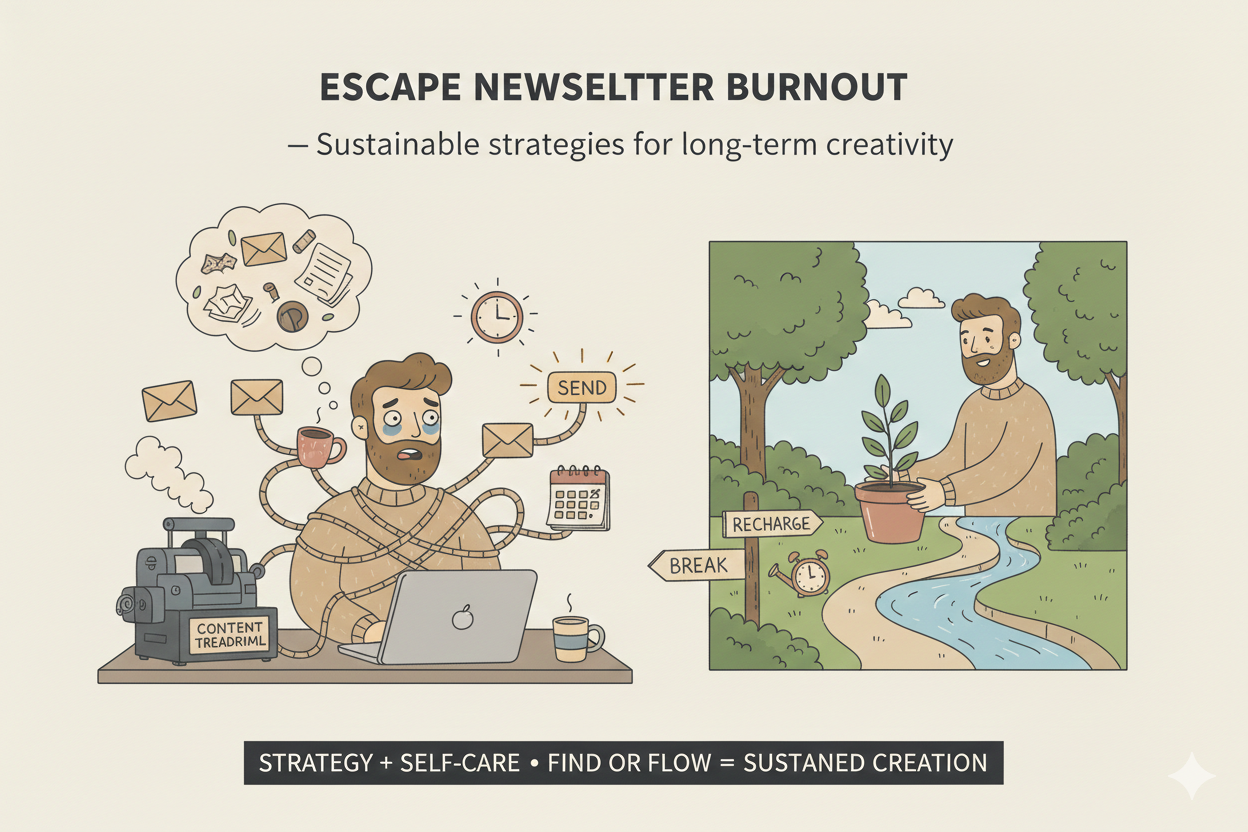
Escape Newsletter Burnout
Sustainable publishing rituals for founders
You promised yourself this time, your newsletter will be consistent. Every week, every issue done. And yet… you're staring at a blank draft, your brain fried, your ideas half-baked. Newsletter burnout is real, and it hits founders hardest. You're juggling product, investors, meetings, and somehow also trying to stay witty and insightful in the inbox.
But burnout isn't a moral failing. It's a system problem. The rituals and processes that get you here don't scale for your energy or attention. You need sustainable systems that keep your newsletter alive without draining your mind.
Here's how founders can escape burnout, preserve creativity, and build newsletters that grow without killing themselves in the process.
1. Accept a realistic cadence
Consistency is important but obsession is dangerous. Decide what you can sustainably produce without sacrificing quality or sanity:
- Weekly, biweekly, or even monthly? Choose the rhythm that aligns with your energy.
- Less frequent but higher-quality beats frequent mediocre issues.
- Treat cadence like a metric of sustainability, not heroism.
Burnout often comes from trying to "keep up" with every newsletter trend or peer. Decide your pace and own it. Understanding the best send times can also help you optimize your schedule.
2. Batch content creation
Your brain can't jump from sprint to sprint every week. Batching solves this:
- Dedicate 2–3 hours to create multiple issues in one session.
- Outline, draft, or even fully write a month's worth of content.
- Schedule sends so your newsletter flows automatically.
Batching creates breathing room for creative thinking and reduces last-minute stress.
Burnout rate by publishing frequency
% of creators who quit publishing within 12 months at each cadence.
The most sustainable frequency is weekly. It's also the best-performing cadence for open rates and subscriber retention.
Open rate by publishing frequency
More emails ≠ more engagement. Scarcity drives anticipation.
Weekly hits the optimal point: high enough engagement, sustainable enough to maintain quality.
3. Reuse and repurpose wisely
Not every newsletter must be 100% new material:
- Pull insights from product updates, blog posts, or social media threads.
- Repurpose interviews, lessons learned, or case studies into digestible issues.
- Revisit high-performing old content with updates or fresh commentary.
The story-based newsletter framework can help you structure repurposed content effectively. Recycling intelligently keeps your pipeline full without draining you.
4. Create a "content bank"
Always have a reservoir of ideas and drafts ready:
- Maintain a running document of story ideas, lessons, or tips.
- Whenever inspiration strikes, jot it down even if you won't use it immediately.
- Pull from this bank when you feel depleted or uninspired.
A content bank ensures you're never starting from zero. This also helps maintain a high-converting newsletter format consistently.
Newsletter time audit: weekly average by creator type
| Task | Unoptimized | Optimized | Time saved |
|---|---|---|---|
| Topic ideation | 2 hrs | 20 min | 1h 40m ✓ |
| First draft | 3 hrs | 45 min | 2h 15m |
| Editing / refinement | 2 hrs | 30 min | 1h 30m ✓ |
| Design / formatting | 1 hr | 15 min | 45m |
| Subject line testing | 30 min | 10 min | 20m |
| Total per issue | 8.5 hrs | 2 hrs | 6.5 hrs saved ✓ |
'Optimized' assumes a repeatable template, an idea bank, and a drafting-first workflow. No shortcuts on quality, just removing friction.
5. Set boundaries and protect energy
Your newsletter shouldn't take over your life. Protect your headspace:
- Block dedicated writing hours, no calls, no distractions.
- Give yourself off-days; creativity needs rest.
- Limit over-analysis; perfectionism kills momentum.
Your audience benefits more from consistent, readable newsletters than "perfect" weekly masterpieces. Remember, personality matters more than polish.
6. Build micro-rituals that cue productivity
Small rituals reduce friction and create habit:
- Start with a 5-minute freewrite or journal prompt.
- Light a candle, brew a coffee, or clear your desk to signal focus.
- End sessions with a checklist or next-step note so you can pick up easily.
Rituals turn the mental load of writing into automatic, repeatable actions.
Publish consistently for years, not months.
Weekly is the proven sweet spot. Not daily, not 3×. Weekly gives you time to think, lets ideas marinate, and keeps readers anticipating rather than fatigued.
Keep a running note of ideas, quotes, observations, and reader questions. Never start from blank. Spend 10 minutes a day adding to it, not 2 hours scrambling on deadline.
Same structure every week. Readers learn where to find things. You write faster because the container is fixed. Creativity lives within constraints, not despite them.
7. Leverage community and accountability
Writing in isolation amplifies stress. Surround yourself with support:
- Share drafts with a trusted co-founder, peer, or editor for feedback.
- Join small creator groups or newsletter masterminds for accountability.
- Celebrate wins, not just metrics, every issue shipped counts.
Community keeps you motivated and reminds you why you started in the first place. If you're feeling stuck, learning to revive a stalled newsletter can provide actionable next steps.
Newsletter burnout is not a sign of weakness. It's a signal to change the system, not the creator. Founders succeed when they design processes around energy, focus, and sustainability.
At Inbox Alchemy, we help founders craft newsletter rituals that preserve creativity, build loyalty, and grow consistently without burning out. Your newsletter should amplify your voice, not consume it. Schedule a consultation to build sustainable systems for your newsletter.
Frequently Asked Questions
How often should I realistically publish? Enough to maintain consistency, but not so much it drains you. Weekly, biweekly, or monthly works depending on energy and resources. Focus on metrics that matter, not arbitrary frequency goals.
Can batching actually reduce burnout? Yes. Batching turns writing from a reactive scramble into a controlled, predictable workflow.
What if I run out of ideas? Keep a content bank. Repurpose, update, and recycle ideas to maintain momentum. Identifying your newsletter personality type can also unlock fresh angles.
How do I maintain quality under burnout? Focus on sustainability over perfection. A readable, authentic issue trumps a polished, late one.
Can rituals really help? Absolutely. Micro-rituals reduce friction, cue focus, and preserve energy for creativity.
Written by

Investor • Founder • Creator
Ryan Estes is co-founder of Kitcaster, an eight-figure bootstrapped podcast booking agency acquired by Moburst in 2025. He created AI for Founders, a podcast, newsletter, and workshop platform reaching 47,000+ entrepreneurs and CEOs. Based in Denver, Colorado.