How a Newsletter Shortens Sales Cycles Before You Ever Get on a Call
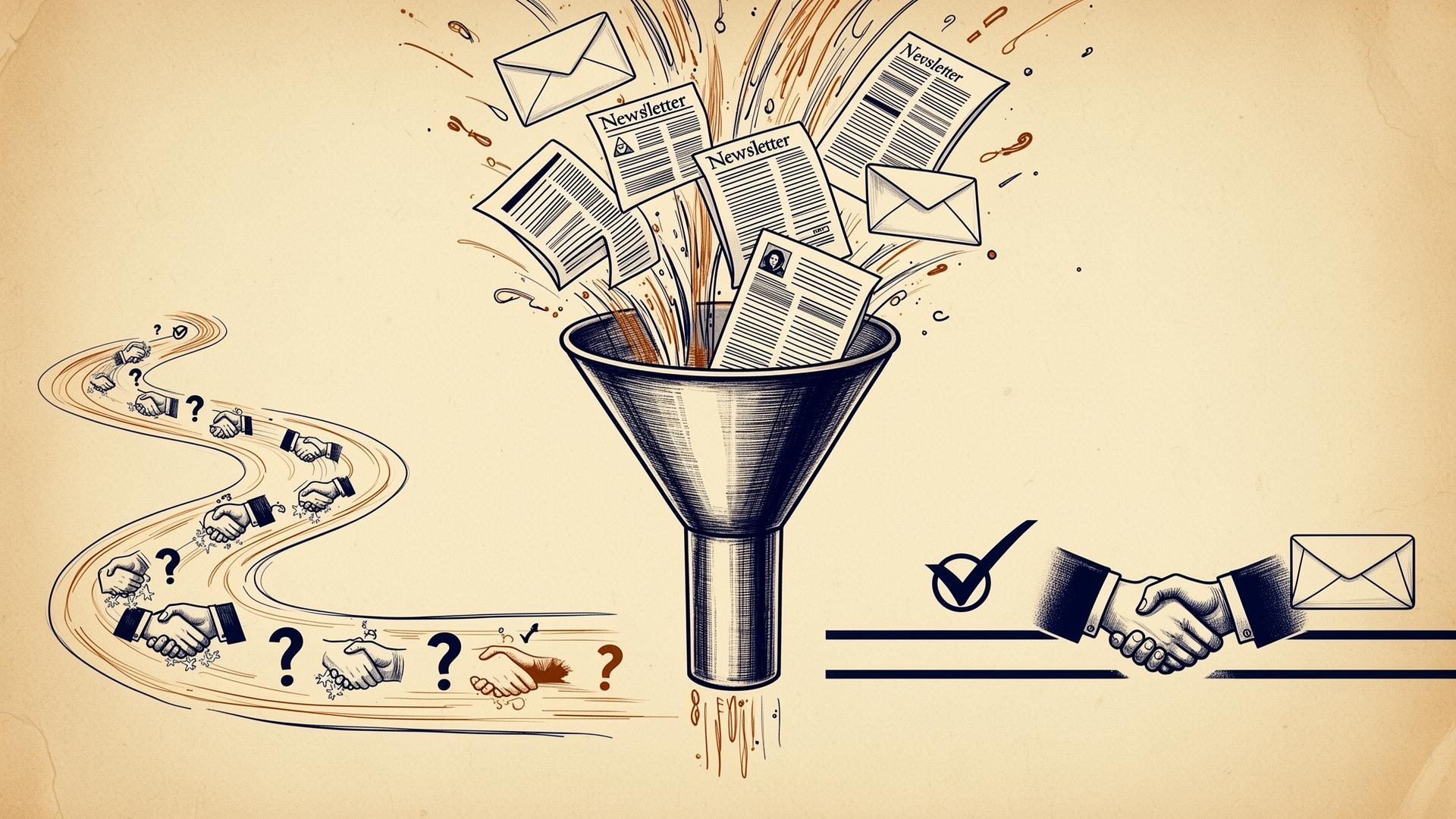
Pre-selling through trust.
The most valuable thing you can do before a sales call is make the call feel unnecessary.
Not because selling is bad, but because the moment a prospect picks up the phone already knowing who you are, already trusting your perspective, and already half-convinced you are the right solution, the entire dynamic shifts. You are no longer a stranger pitching. You are a known quantity being confirmed.
That transformation does not happen through cold outreach. It does not happen through a compelling LinkedIn profile or a well-targeted ad. It happens through consistent, trusted, permission-based communication over time. It happens through a newsletter.
This article makes the case, with data, with real-world examples, and with how modern B2B buying actually works in 2025 and 2026, that a well-run newsletter is the most powerful sales cycle compression tool available to any business that sells on relationships, expertise, or trust.
The Modern Sales Cycle Has Already Moved Without You
Before we talk about the solution, we need to sit with the problem.
The game changed, and most sales teams are still playing by the old rules.
6Sense's 2025 Buyer Experience Report, built from more than 4,000 buyer interviews across North America, EMEA, and APAC, confirmed something that should reshape how every B2B business thinks about its go-to-market motion: buyers are making up their minds long before they ever speak to a seller. The buying journey now splits roughly 60/40, with 60% of the process completed through independent research before any vendor contact happens. In 2024, that figure was 70/30. The compression is accelerating.
More striking still, 6Sense found that 94% of buying groups had already ranked their preferred vendors before making first contact, and the preliminary favorite went on to win the deal 77% of the time. The first call, in other words, is not the beginning of the sales process. For most buyers, it is closer to the end.
That means sellers who spend their first conversation building credibility and establishing relevance have already lost the race. The shortlist was formed without them. The trust was awarded or withheld before a single proposal was written.
What wins the deal, then, is what happened during the months of independent research that preceded that first call. Specifically, it is whether your brand was present, useful, and trusted during the period 6Sense's researchers describe as "the critical period", the long stretch of anonymous research where buyers form their vendor preferences, establish their requirements, and build the shortlists they will quietly carry into every subsequent conversation.
A newsletter is precisely how you occupy that space.
What Pre-Selling Actually Means
The term pre-selling gets used loosely, so it is worth being precise. Pre-selling is not a teaser campaign. It is not a drip sequence of promotional emails. It is the process of removing the core friction points in a sales conversation, skepticism about your credibility, uncertainty about your understanding of the buyer's problem, doubt about whether your approach fits their world, before those friction points ever come up.
When a prospect subscribes to your newsletter and receives six months of consistent, intelligent, genuinely useful content, they arrive at the first sales conversation having already resolved most of those friction points on their own. They have seen you think through problems similar to theirs. They have watched you engage with the nuances of their industry. They have noticed that your perspective is consistent, that you are not just saying what people want to hear, and that the quality of your thinking matches the quality of the outcome you are promising.
That prospect is not the same prospect as someone who found you through a cold outreach sequence or clicked on an ad. Research consistently shows that warm outreach conversion efficiency is 5 to 10 times higher than cold outreach, and sales cycles with warm leads, those who have prior relationship or demonstrated interest, can be shorter by as much as half compared to cycles that begin from cold.
The newsletter is the mechanism that turns a cold prospect into a warm one, without a single cold call.
Average B2B sales cycle length by lead source
Months from first contact to closed deal.
A long-time newsletter reader arrives at the first call already convinced of your credibility. You skip the trust-building phase entirely.
Discovery call outcomes by lead source
% of first calls that advance to proposal stage.
The Trust Architecture That Newsletters Build
88% of B2B customers only buy once they see the salesperson as a trusted advisor. That single statistic reframes the entire discussion about what a newsletter does. It is not a content marketing tactic. It is not a list-building exercise. It is the infrastructure for becoming a trusted advisor at scale, to hundreds or thousands of potential buyers simultaneously, before you have ever had a single individual conversation with any of them.
Think about what earns trusted-advisor status in a human relationship. Consistency. Demonstrated expertise. The perception that you understand the other person's problems better than they might expect. A track record of being right, or at least thoughtful. The feeling that they would get something valuable from every interaction, not just a pitch.
A newsletter, issued consistently and written with genuine investment in the reader's success, delivers all of those things. Each issue is a trust deposit. Over weeks and months, those deposits compound into something that no amount of cold outreach can replicate: the sense that you were there, reliably, before they needed you.
83% of B2B marketers have seen a noticeable difference in sales opportunities between nurtured leads and non-nurtured leads. The newsletter is the nurture vehicle that operates at the highest level of authenticity, because the subscriber chose to receive it, and continues to choose it every time they open it.
The Real-World Case: Newsletters That Built Pipelines Before the Pitch
Abstract arguments matter less than what actually happens in practice. And the examples here are hard to dismiss.
Morning Brew started in 2015 as a single email newsletter for college students. Today, its professional B2B division, covering marketing, HR, tech, finance, and retail, generates $25 million in annual revenue. Subscribers to its seven professional newsletters doubled between 2022 and 2024. The company's growth was not built on advertising spend or cold outreach. It was built on trust, accumulated one inbox at a time, until the brand became the first thing decision-makers read in the morning.
Lenny Rachitsky's newsletter, written by a former Airbnb product lead and focused on product strategy and growth, now reaches over 700,000 subscribers and generates more than $4 million annually. Lenny does not run paid ads. He does not cold email prospects. His entire business, consulting engagements, conference invitations, sponsorships, and course revenue, flows from the trust built through consistent, high-quality issues delivered to subscribers who chose to be there.
The consulting firm Punctuation generates $1.7 million in annual revenue from just 13,000 newsletter subscribers, roughly $130 in revenue per subscriber annually. These are not passive followers. They are subscribers who trust the firm's perspective so deeply that they become clients without ever being cold-pitched. And at enterprise scale, the same pattern holds: Xerox traced $1.3 billion in pipeline to its systematic newsletter program, while Optum attributed $52 million in closed contracts to newsletter-driven nurture.
The pattern across all of these examples is identical. Consistent, useful communication to a permission-based audience, over time, creates a trust relationship that compresses the sales conversation from a credibility-building exercise into a logistics discussion.
The Buyer's Journey Has Changed, Your Newsletter Needs to Reflect That
The modern B2B buying journey does not start with an RFP and end with a signed contract. It starts with a problem recognition that the buyer may not yet have language for. It moves through informal research, peer conversations, content consumption, shortlisting, and internal alignment, all before any vendor gets a phone call.
As the Demand Gen Report noted in its April 2025 analysis, a newsletter keeps your brand at the forefront of buyers' minds, making it the first option they consider when they are ready to make a purchase. That front-of-mind positioning is not accidental. It is the direct result of showing up in a trusted context, at a consistent cadence, with content that addresses the real problems buyers are working through.
6Sense's buyer research reveals that buyers build their Day One shortlists with 4 of the 5 vendor spots filled immediately, based on brand familiarity, peer input, and prior exposure. The strategic implication is clear: the goal of a newsletter is not to convert subscribers at the moment they read it. The goal is to ensure your brand is already in one of those automatic shortlist positions when the buying journey begins.
Lead nurturing research confirms it takes between 5 and 20 touchpoints for a lead to convert. The newsletter is the most elegant and scalable way to deliver those touchpoints, because each issue arrives in a context the reader chose, on the topic they opted into, at a cadence that signals your commitment without demanding theirs.
Why the Inbox Is the Right Place for Pre-Selling
Not all channels are equally suited to pre-selling. Social media is excellent for awareness and broadcasting short-form ideas. But it is a structurally poor environment for the depth and consistency that pre-selling requires.
Social feeds are designed for consumption, not decision-making. The mental mode a reader is in when scrolling LinkedIn or Instagram is not the mode in which they evaluate whether to trust a vendor. They are in entertainment mode, not investment mode. A newsletter in the inbox lands in a different context: 99% of email users check their inbox every day, and 55% do so within the first ten minutes of waking up. This is an intentional, task-oriented space.
The inbox is also the space where commercial decisions live. Purchase confirmations, contract documents, meeting requests, proposals, all of it flows through email. A newsletter that occupies the same mental channel as those high-stakes communications benefits from that association. The subscriber's orientation toward their inbox is fundamentally more serious and more commercially minded than their orientation toward any social feed.
This is why email consistently outperforms other channels on ROI, and why 77% of B2B buyers say they prefer to be contacted by email. The channel is not just efficient. It is the right environment for the kind of trust-building that pre-selling requires.
The Compounding Effect: Every Issue Raises the Floor
One of the most underappreciated aspects of a newsletter as a pre-selling tool is that it compounds. A social post has a half-life of hours. A newsletter issue becomes part of a growing body of evidence that the reader can access, reference, and be influenced by over time.
Consider what happens over six months of consistent weekly issues. A prospect who subscribed in January and is considering a purchase decision in July has, by that point, received 26 issues from your brand. Each of those issues has either confirmed or deepened their trust in your perspective. They have seen how you handle uncertainty, how you respond to industry developments, whether your predictions pan out, whether your advice is practical. They have, in effect, run a shadow evaluation of you as a vendor across 26 separate data points, without your even knowing they were considering you.
When that prospect finally requests a call, they are not starting from zero. The sales cycle, for them, has already been running for six months. The work of building credibility, demonstrating expertise, and establishing rapport has already been done. The call is not the beginning of the relationship. It is the confirmation.
This is the mechanism through which a newsletter shortens sales cycles, not by accelerating the formal process, but by compressing the trust-building phase that normally happens inside that process, and moving it entirely upstream.
What the Data Says About Nurtured Leads
The commercial impact of this pre-selling is measurable and significant.
Nurtured leads make purchases that are 47% larger than non-nurtured leads. Companies that excel at lead nurturing generate 50% more sales-ready leads at 33% lower cost. And B2B email marketing is considered the second most efficient tool for lead generation, delivering 32% of engaged leads on average, with 59% of B2B marketers naming email their single most effective channel for generating revenue, outperforming paid search and social combined.
The reason for these numbers is not mysterious. It is the accumulated effect of consistent, relevant, trust-building communication in a channel the reader controls and chose. That is exactly what a newsletter provides.
Objection Handling Without a Call
One of the most concrete ways a newsletter shortens the sales cycle is by handling objections before they are raised.
Every sales professional knows the common objections in their category. In every industry, there is a short list of doubts that come up on every call: Why should I trust you over a competitor? What makes your approach different? Have you solved my specific problem before? How do I justify this to my CFO?
A newsletter gives you the ability to answer all of those questions in writing, with evidence, before a prospect ever articulates them aloud. A well-crafted issue that walks through a client case study is not just interesting content. It is preemptive objection handling. An issue that explains the reasoning behind your methodology is not just thought leadership. It is a silent response to every prospect who has ever questioned whether your approach would work for them.
By the time that prospect gets on a call, the objections have often already dissolved, replaced by a framework the newsletter built, over time, in the exact terms the prospect would use themselves. That shift makes the conversation shorter, more productive, and far more likely to close.
The GEO Dimension: Newsletters as AI-Discoverable Authority
There is a 2025-specific dimension to the pre-selling power of newsletters that deserves direct attention: generative engine optimization (GEO).
TrustRadius research found that 72% of buyers encountered Google's AI Overviews during their research, and 90% clicked through to at least one cited source. The brands that appear in those AI-generated summaries are not there by accident. They are there because they have published consistent, substantive, authoritative content that answer engines can reference.
6Sense's 2025 research confirmed that 94% of buyers used AI tools during the buying process, primarily to synthesize and organize research. That means when buyers ask ChatGPT, Perplexity, or Google's AI Overviews for vendor recommendations in your space, the brands with deep, consistently updated content libraries are systematically more likely to surface.
A newsletter archive published as web-native content is exactly that kind of library. Each archived issue adds topical depth, builds entity authority in your niche, and creates the kind of first-party signal that AI-driven discovery engines favor over the thin, ephemeral content of social feeds. The newsletter is doing pre-selling work not only in the subscriber's inbox, it is doing pre-selling work in the AI-mediated research phase that might precede the subscriber relationship entirely.
As B2B Growth Secrets reported in November 2025, cold calling success rates have plummeted 52% in just one year while cold email open rates dropped 23% year-over-year. The old outbound playbook is dying from saturation. The businesses gaining ground are those investing in owned distribution and content authority, the two things a newsletter builds automatically, one issue at a time.
What a Newsletter Cannot Do, and What That Tells You
It is worth being honest about the limits. A newsletter does not close deals. It does not replace the relationship work of a skilled sales professional. It will not convert a prospect who is fundamentally not a good fit.
What a newsletter does is ensure that by the time a good-fit prospect gets on a call, the conversation is not about whether to trust you. It is about how to work together.
That shift, from trust-building to logistics, is where the real sales cycle compression happens. When sellers and buyers align on the problem definition from the first conversation, win rates improve by 38%. A newsletter that has done its job ensures that alignment is already present before the first call begins. The call becomes a formality, not a test.
Building the Newsletter That Pre-Sells
What does a pre-selling newsletter actually look like in practice? The answer is less complicated than it sounds, but it requires commitment to a few non-negotiable principles.
It has to be consistently useful, not consistently promotional. As Litmus Director of Brand and Content Jaina Mistry told Demand Gen Report, the most successful newsletters prioritize providing value to audiences over promotional content, delivered consistently. The moment a subscriber starts to feel the newsletter is primarily a vehicle for selling, the trust deposits stop accumulating and the pre-selling effect evaporates. The newsletter that pre-sells most effectively is the one the reader would miss if it stopped arriving.
It has to demonstrate a specific point of view. Generic information does not build trusted-advisor status. The newsletters that pre-sell most effectively, from GTMnow's tactical revenue breakdowns to Lenny Rachitsky's opinionated product frameworks, are the ones that take positions, make predictions, explain the reasoning behind recommendations, and are willing to be disagreed with. That kind of intellectual commitment is what turns a content piece into a trusted voice.
And it has to be patient. The pre-selling effect is not visible in the first issue, or the fifth, or the fifteenth. It builds across the arc of a long relationship. The businesses that benefit most from newsletters as pre-selling tools are the ones that commit to the long game, those that understand they are building an asset, not running a campaign.
The good news is that the asset they are building is one their competitors cannot easily copy, because trust, unlike content, cannot be produced on demand or purchased from a platform. It has to be earned, over time, in the inbox.
That is exactly what a newsletter does.
Sources: 6Sense 2025 Buyer Experience Report · 6Sense: The Critical Period for B2B Buying · 6Sense: Buyers Are Even Less of a Blank Slate · Corporate Visions: B2B Buying Behavior Statistics 2026 · Demand Gen Report: Why Email Newsletters Are a B2B Game-Changer · Encharge: B2B Lead Nurturing 2025 · Stripo: B2B Email Marketing Statistics 2025 · The Digital Bloom: B2B Lead Nurturing Strategies 2025 · B2B Growth Secrets: The Next B2B Moat · B2B Drum: Cold Email vs Warm Outreach 2025 · Mailshake: 200 Sales Statistics 2025 · Axios: Morning Brew Rebrands as B2B Products Grow · Dock: 26 Must-Read B2B Newsletters
Frequently Asked Questions
Q: How early in the sales process does a newsletter actually start influencing a buyer's decision? Research indicates that 60% of the B2B buying process is complete before a buyer ever contacts a vendor. Newsletter subscribers who are evaluating a purchase are in that 60% phase — reading, researching, and forming preferences — long before they schedule a call. A newsletter that consistently shows up during this phase shapes shortlist formation, sets the frame for what "good" looks like, and positions the publisher as the default trusted option before a proposal is ever requested.
Q: How many newsletter touchpoints does it typically take before a subscriber becomes a qualified lead? There is no universal number, but the research cited in the post suggests that leads requiring 10 or more touchpoints before converting close at dramatically higher rates and with lower churn than leads pushed through fewer interactions. A newsletter running weekly sends 52 touchpoints per year — more than any other marketing channel can deliver cost-effectively, and all delivered in a trusted, private space the subscriber explicitly opted into.
Q: Can a newsletter shorten sales cycles for founder-led sales, or only for scaled teams with formal processes? Particularly for founder-led sales, where trust in the individual is often the key conversion factor, newsletters are exceptionally effective. A prospect who has been reading your newsletter for three months arrives on the first call already trusting your judgment, already familiar with your perspective on their problem, and already half-convinced you are the right person to work with. The call becomes confirmation rather than discovery.
Q: What types of content are most effective for warming B2B buyers through a newsletter? Content that demonstrates your thinking process, not just your conclusions. Case studies that show how you diagnose and solve the specific type of problem your buyer faces, opinion pieces that reveal your standards and values, and practical frameworks your reader can apply immediately — all of these build the kind of credibility that makes a buyer want to work with you specifically, rather than just someone who can solve the problem generally.
Q: How do you measure whether your newsletter is actually shortening sales cycles versus just existing alongside them? Track the average sales cycle length for newsletter subscribers versus non-subscribers in your CRM. Compare time from first contact to close, number of meetings required, and deal close rate between the two segments. Businesses that instrument this comparison almost universally find meaningful differences — the newsletter-subscriber pipeline performs better on every metric because the relationship work happened before the sales process began.
Written by

Investor • Founder • Creator
Ryan Estes is co-founder of Kitcaster, an eight-figure bootstrapped podcast booking agency acquired by Moburst in 2025. He created AI for Founders, a podcast, newsletter, and workshop platform reaching 47,000+ entrepreneurs and CEOs. Based in Denver, Colorado.