How to Build a Newsletter Audience That Actually Wants You
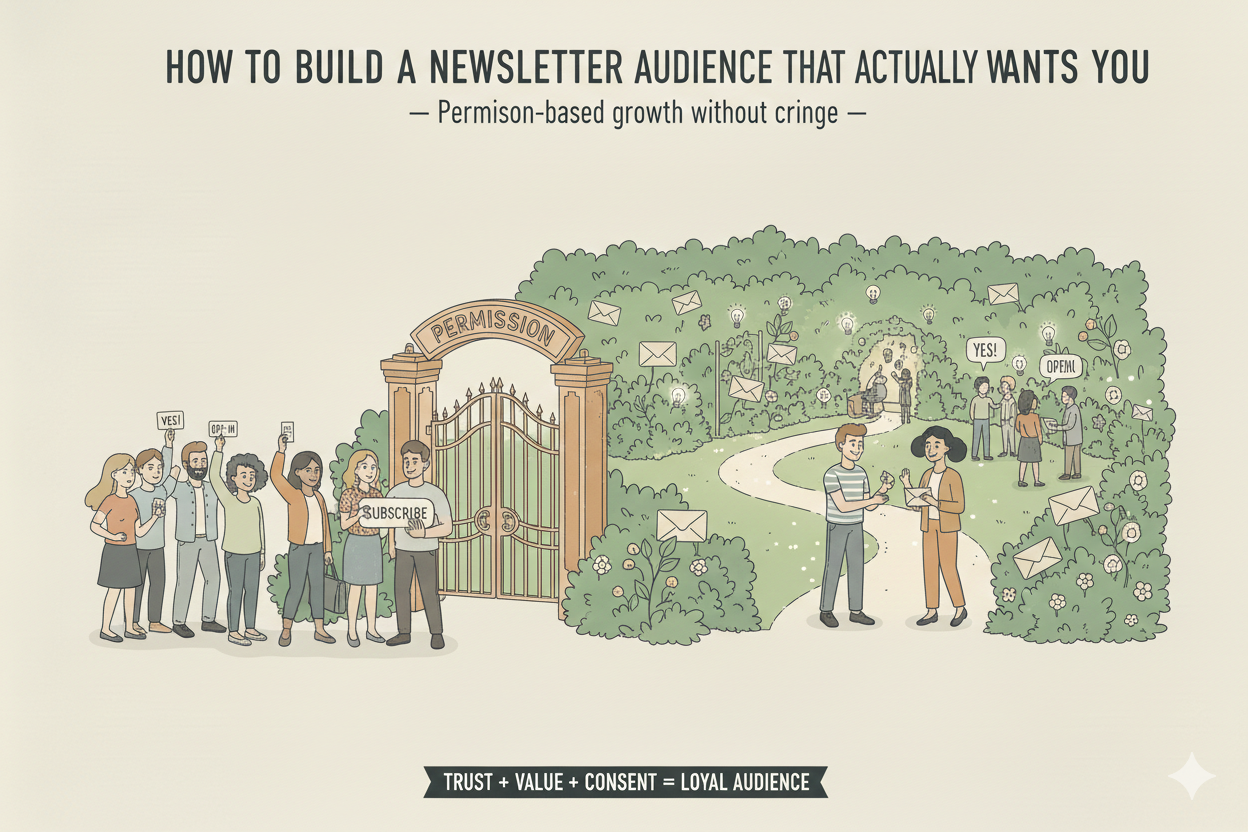
You are growing your newsletter backwards, and here we're going to show you how to fix that.
Most creators chase subscribers before they earn attention. They optimize for growth before they establish trust. They focus on scale before understanding consent. The result is familiar: a list that technically grows but doesn't respond, subscribers who skim quickly and disappear silently, and an audience that never truly chooses you.
Real newsletter growth doesn't feel like extraction. It feels like permission.
Why most newsletter growth feels cringe
Cringe happens when intent and experience don't match.
Common examples include:
- "No spam, unsubscribe anytime" banners that still lead to daily blasts
- Lead magnets promising transformation but delivering PDFs
- Forced urgency that pretends every email is essential
- Over-personalization that feels invasive rather than thoughtful
These tactics may work short term because they manipulate curiosity or fear. They fail long term because they violate trust. Subscribers are not fooled. They may opt in, but they don't opt in emotionally. Emotional opt-in is what sustains growth.
Permission is not a checkbox
Many creators treat permission as a technical requirement: email entered, consent box checked, welcome email sent.
That's legal permission, not psychological permission.
Psychological permission answers a deeper question: "Do I want this voice in my inbox again?"
Subscribers grant that permission repeatedly. Every send is a renewal. When growth stalls, it's often because creators assume permission is permanent. It isn't. Understanding the metrics that actually matter helps you track whether you're maintaining that permission.
12-month subscriber retention by acquisition intent
Intent = how intentional was the subscriber when they joined?
Retention is determined at the moment of signup, not after. Build channels that attract people who came for you, not the incentive.
The real reason people subscribe
People don't subscribe to newsletters for information.
They subscribe for:
- Perspective
- Interpretation
- Reduction of cognitive load
- A voice they trust to filter reality
Information is abundant. Meaning is scarce. If your newsletter can be replaced by a search result, permission will always be fragile.
The strongest audiences subscribe not because they need updates, but because they value how you see things. This is why making your newsletter feel human is essential for long-term retention.
Growth starts before the opt-in
Most newsletter advice starts at the signup form. That's already too late.
Permission-based growth starts upstream, in public. Your posts, essays, comments, and conversations create a preview of the relationship. Before someone subscribes, they are asking:
- Do I agree with this worldview?
- Do I like how this person thinks?
- Do I want more of this cadence?
The best newsletters feel inevitable to subscribe to. By the time the opt-in appears, the decision is already made. Learn more about getting your first 1,000 subscribers with this approach.
Why "lead magnets" often dilute audiences
Lead magnets optimize for volume, not alignment. They attract people who want the asset, not the relationship. This creates three problems:
- Inflated lists with low intent
- Misaligned expectations about future emails
- Higher churn once the magnet is delivered
Permission-based growth flips the model. Instead of offering a bribe, you offer continuity: "You've read this. If you want more like it, here's where it lives."
That attracts fewer subscribers but better ones. And better ones compound,which is why newsletters compound forever when built on trust.
Clarity beats cleverness at the point of signup
Many signup pages try to impress. They overpromise, hedge, or sound like marketing.
Permission grows faster when expectations are explicit. Strong signals include:
- How often you send
- What you talk about
- Who it's for
- Who it's not for
Specificity repels the wrong people and attracts the right ones. That's not a bug,it's the entire point. A smaller list with high consent outperforms a large list with low trust every time.
Writing that earns permission over time
Even the best signup experience can't compensate for weak delivery. Permission is earned send by send.
Emails that sustain consent share common traits:
- They respect the reader's time
- They say something real, not recycled
- They avoid artificial urgency
- They don't pretend every issue is critical
Readers forgive missed weeks. They don't forgive wasted minutes. Consistency matters but relevance matters more. For tactical frameworks, explore our guide on high-converting newsletter formats.
Engagement is a lagging indicator of trust
Open rates don't measure desire. Replies do. Forwarding does. Readers referencing your ideas elsewhere does.
High-trust newsletters often have:
- Fewer subscribers
- Higher reply ratios
- Lower churn
- Longer lifespans
If engagement feels forced, permission was never fully granted. If engagement feels natural, growth follows quietly. Our founders engagement playbook dives deeper into building this kind of authentic engagement.
Distribution that respects consent
Where you promote your newsletter matters as much as how. Permission-aligned distribution looks like:
- Linking after delivering value
- Inviting rather than insisting
- Showing, not telling, why it's worth subscribing
The fastest way to kill trust is to ask for attention before earning it. The fastest way to earn it is to make subscribing feel like the obvious next step. Compare this to newsletters vs social media to understand where your efforts compound best.
Growth without cringe is slower, then faster
Permission-based growth feels slow early. There are fewer spikes. Fewer viral moments. Less artificial momentum.
Then something shifts. Subscribers stick. They recommend you organically. They reply without prompting. They stay when you change formats or cadence.
That kind of growth is quiet but durable. It doesn't rely on tricks. It relies on alignment.
Build the audience you want to write for
At Inbox Alchemy, we don't believe in audience growth at any cost. We believe in building audiences that choose you intentionally, stay subscribed deliberately, and engage because they want to,not because they were coerced.
Permission-based growth is not about faster tactics. It's about cleaner foundations. When you earn consent before asking for attention, newsletters stop feeling like marketing and start feeling like relationships. And that's what real growth is built on.
Ready to build a newsletter audience that truly wants you? Schedule a free consultation to discuss your permission-based growth strategy.
Frequently Asked Questions
Q: How do I attract subscribers who actually want to hear from me?
A: Focus upstream. Publish posts, essays, and commentary that show your voice. When people recognize value in your perspective, subscription feels like a natural next step.
Q: Are lead magnets harmful?
A: Not inherently, but if they attract people for the asset instead of the relationship, they dilute audience alignment and increase churn. Continuity beats bribes.
Q: How often should I email my audience?
A: Consistency matters, but relevance matters more. Send as often as you can sustain value without creating friction or fatigue. Learn about the best send times to optimize your delivery.
Q: How can I tell if my audience is truly engaged?
A: Track replies, forwards, and references outside the inbox. These are stronger indicators of permission and trust than open rates alone.
Q: Can I scale a newsletter ethically and still grow fast?
A: Yes. Growth follows naturally when you respect permission, attract aligned subscribers, and earn attention every send.
Written by

Investor • Founder • Creator
Ryan Estes is co-founder of Kitcaster, an eight-figure bootstrapped podcast booking agency acquired by Moburst in 2025. He created AI for Founders, a podcast, newsletter, and workshop platform reaching 47,000+ entrepreneurs and CEOs. Based in Denver, Colorado.