Use Your Newsletter to Drive Deal Flow
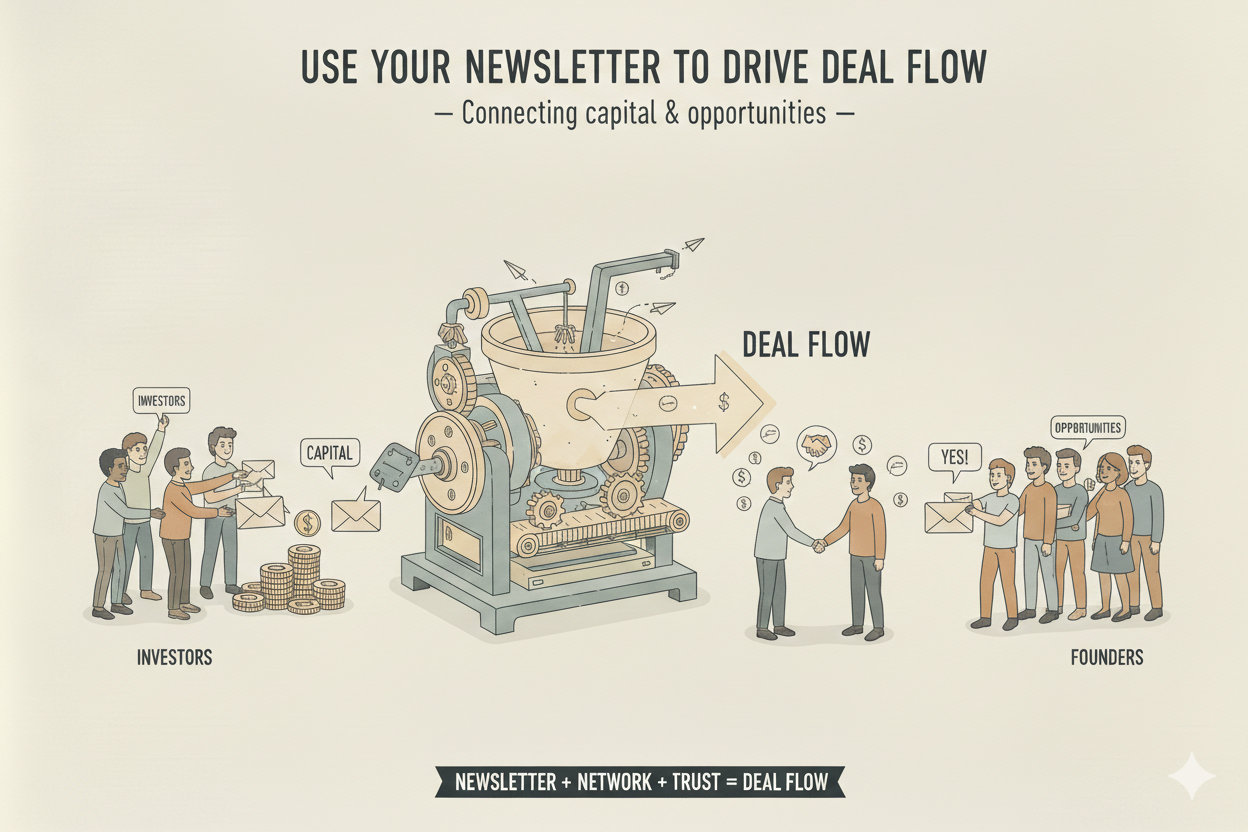
You are waiting for the call. Expecting that email to arrive and close the deal. And instead… inbox zero. Nothing. That's because most founders treat newsletters like content experiments. They send updates, share insights, hope someone notices and hope somehow it translates into business. It doesn't. Newsletters are not experiments. They are pipelines.
Every email you send is an opportunity to convert trust into real, inbound business,but only if you design it that way.
Why newsletters are the secret weapon for deal flow
Most deal pipelines are outbound. Cold emails, LinkedIn DMs, and ads dominate. These tactics are noisy, expensive, and hard to scale.
Newsletters, when done right, are different:
- You own the audience. No algorithm decides who sees your content.
- Every send reinforces trust and positions you as the authority.
- Subscribers self-select into engagement, giving you high-intent leads.
Trust translates into business. When people open, read, and reply, the newsletter becomes a magnet for opportunity. This is why newsletters compound forever,each issue builds on the last.
The psychology behind inbox-driven business
Subscribers treat your emails differently than other content. A newsletter lives in a private, trusted space,their inbox. Unlike social media, you aren't fighting for attention; you are invited.
The psychological sequence is simple:
- Recognition – Readers know your name, voice, and perspective.
- Consistency – Repeated exposure builds credibility.
- Engagement – Opens, clicks, and replies indicate alignment.
- Opportunity – When a problem arises, they think of you first.
Every issue becomes an investment in future inbound business. Understanding the metrics that actually matter helps you track this progression.
How to turn readers into partners, investors, and customers.
Identify the exact type of person you want in your deal pipeline. Write every issue to that one reader. The right people will self-select in and the wrong ones will leave.
Share how you analyze a problem, what frameworks you use, what you got wrong. Sophisticated operators and investors want to see inside your mind.
Include a consistent section on what you are building, what partners you are looking for, or what problems you are solving. Readers who match will raise their hand.
Step 1: Define your newsletter's deal-flow intent
Not every newsletter is built to drive business. If your goal is leads, you need clarity:
- Who is your ideal client or partner?
- What problem do you solve that is high-value to them?
- How will your content prime them for conversation without being salesy?
Your newsletter becomes a trust-first pipeline, not a spammy sales channel. For tactical frameworks, explore our guide on high-converting newsletter formats.
Step 2: Create content that earns trust and positions you
Trust isn't given. It's earned. Every email should either:
- Teach something valuable
- Share perspective unavailable elsewhere
- Tell a story that highlights your expertise
- Demonstrate results without overselling
Your content must signal capability without forcing action. When readers internalize your competence, they naturally come to you when opportunities arise. Learn more about making your newsletter feel human to build authentic connections.
Step 3: Make your calls to action subtle but intentional
Deal flow doesn't require hard sells. In fact, aggressive pitches hurt long-term credibility. Instead:
- Include optional ways to engage: "Reply if you want to dive deeper"
- Drop occasional case studies or client outcomes in context
- Share insights that naturally prompt discussion
Every CTA should feel like a continuation of the relationship, not a sales interruption.
Step 4: Segment and personalize for impact
A one-size-fits-all newsletter works for reach, not deal flow. Segmentation improves relevance:
- Separate audiences by role, industry, or engagement level
- Tailor messaging to the problems they care about
- Highlight content that signals your ability to solve their specific challenge
Targeted newsletters create higher-quality conversations and reduce wasted bandwidth. This approach helps you move subscribers from cold to warm.
Step 5: Treat replies like gold
When a subscriber replies, a deal may be one conversation away.
- Respond promptly.
- Make the conversation human, not transactional.
- Use insights from their reply to improve future issues.
Every interaction is both a learning opportunity and a pipeline activation. Our founders engagement playbook dives deeper into building meaningful two-way conversations.
Step 6: Build scarcity into accessibility
If everyone can engage with you equally, bandwidth becomes a bottleneck. Scarcity can enhance perceived value:
- Make it clear who you typically work with.
- Use language like "I work with a few founders/partners each quarter."
- Highlight selective availability without being arrogant.
People who perceive your time as valuable are more likely to act when they need you.
Step 7: Measure the right signals
Traditional newsletter metrics (opens, clicks) matter, but for deal flow, focus on:
- Replies and inbound inquiries
- Meetings booked from newsletter interactions
- Referrals generated
- Repeat engagement over time
Track these, refine content and CTAs, and watch the pipeline grow organically. Compare this to newsletters vs social media to understand where your efforts compound best.
The founder-led advantage
Newsletters give founders a direct connection to their audience. Unlike ads, cold outreach, or social media, this connection is permissioned and consistent. When your perspective and expertise live in someone's inbox, you become the first call they think of when opportunity arises.
This is not about short-term spikes. It's about building a sustainable, high-trust pipeline where inbound business is the natural outcome of relationship equity. Learn how to build an audience that actually wants you to maximize this advantage.
Final thoughts: newsletters as a business engine
A newsletter is more than content. It is a founder-led deal generator. Every issue is a touchpoint that compounds trust. Every reply is a potential conversation. Every read builds credibility.
At Inbox Alchemy, we help founders craft newsletters that aren't just opened,they generate conversations, opportunities, and inbound business. Done right, your newsletter stops being "just a newsletter" and becomes your most scalable business development tool.
Ready to turn your newsletter into a deal-flow machine? Schedule a free consultation to discuss your strategy.
Frequently Asked Questions
Q: Can a newsletter really generate inbound deals consistently?
A: Yes. With clear intent, trust-building content, subtle CTAs, and thoughtful segmentation, newsletters become predictable pipelines.
Q: How often should I email if my goal is deal flow?
A: Quality over quantity. Send as often as you can provide meaningful insight without overwhelming your audience. Learn about the best send times to optimize delivery.
Q: Should I ever make a hard sales pitch in my newsletter?
A: Rarely. Hard sells reduce trust. Subtle invitations to engage or case-based context work far better.
Q: How do I know if my newsletter is driving real business?
A: Track replies, inbound inquiries, meetings, and referrals that result directly from your emails. Engagement is the true signal.
Q: Can a small newsletter generate high-value deals?
A: Absolutely. A small, highly aligned, permission-based audience often drives better deals than a large, disengaged one. Focus on getting your first 1,000 subscribers the right way.
Framework Summary
- Step 1 — Define deal-flow intent: Clarify who your ideal client or partner is, what high-value problem you solve for them, and how content will prime them for conversation without feeling like a pitch.
- Step 2 — Trust-earning content: Every issue should teach something valuable, share unavailable perspective, tell a story demonstrating expertise, or show results without overselling.
- Step 3 — Subtle but intentional CTAs: Use soft invitations ("Reply if you want to go deeper"), occasional case studies in context, and insights that naturally prompt discussion — never hard sells.
- Step 4 — Segment and personalize: Separate by role, industry, or engagement level; targeted newsletters generate higher-quality conversations and reduce wasted bandwidth.
- Step 5 — Treat replies like gold: Every subscriber reply signals readiness; acknowledge, engage, and move the relationship forward — this is where deals begin.
Written by

Investor • Founder • Creator
Ryan Estes is co-founder of Kitcaster, an eight-figure bootstrapped podcast booking agency acquired by Moburst in 2025. He created AI for Founders, a podcast, newsletter, and workshop platform reaching 47,000+ entrepreneurs and CEOs. Based in Denver, Colorado.