Why Newsletters Create Better Customers Than Social Media Ever Will
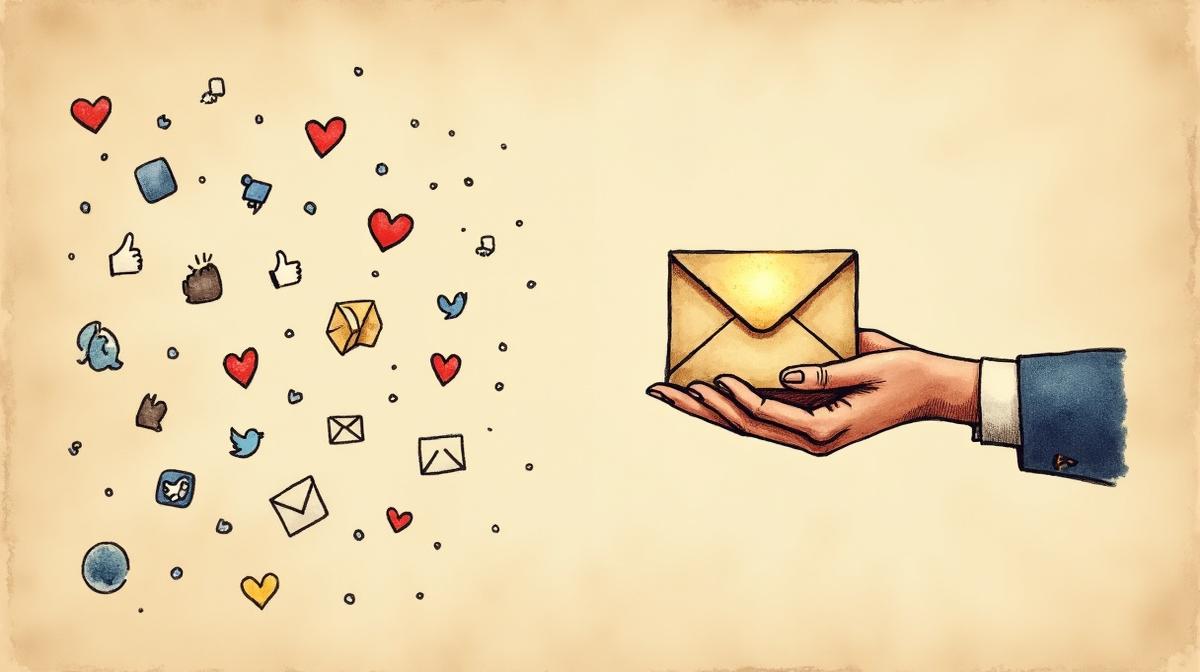
The difference between a follower and a buyer isn't reach, it's intent.
Every week, millions of businesses pour budget, creative energy, and executive attention into social media channels that are, fundamentally, built for passive scrolling. Followers double-tap. They watch. They move on. Meanwhile, a quieter, older, less glamorous channel is outperforming every algorithm update, every viral trend, and every sponsored post on the metrics that actually matter: conversions, lifetime value, and real commercial relationships.
That channel is the email newsletter.
This isn't a nostalgic argument for an older medium. It's a case built on the data from 2024 and 2025, on what happens psychologically when someone invites a brand into their inbox versus stumbling across it in a feed, and on the fundamental difference between a customer who chose you and an audience that was shown you.
The Opt-In Is the First Purchase
Before a newsletter subscriber reads a single word of your content, they have already done something no social media follower has: they made a deliberate, active choice to hear from you.
That distinction is enormous. It is the difference between a guest and a passerby.
When someone follows a brand on Instagram, they are adding it to a pile of hundreds of other accounts that surface unpredictably in a feed designed to keep their attention on the platform, not on your business. There is no commitment in that follow. There is no declaration of interest. The average organic reach on Instagram in 2025 sits at around 3.5%, meaning the overwhelming majority of your followers will never even see a given post, let alone act on it.
Email subscribers are more task-oriented, they approach brand interactions with specific goals in mind, like finding deals, promotions, or new product information. That orientation is not a coincidence. It is the direct consequence of the opt-in. The subscriber has, in effect, pre-qualified themselves. They have told you, without words, that they are willing to be in a commercial relationship with your brand.
This is what marketers call buyer intent, and it is the single most valuable signal in a marketing funnel. Social media is an awareness and discovery engine. Newsletters are a relationship and conversion engine. Conflating the two, or expecting one to do the other's job, is one of the most expensive strategic errors a modern business can make.
The Inbox Is Not the Feed
To understand why newsletters convert better, you have to understand the psychology of the context in which they are consumed.
Social media feeds are engineered for distraction. Every design choice, the infinite scroll, the algorithmically ranked content, the notification badge, is optimized for time-on-platform, not for the quality of your audience's attention. A user may see your post between a meme, a cousin's holiday photo, and a news story. The cognitive state they are in is fragmented, reactive, and deeply non-commercial.
The inbox is different. People open their email with intention. Email users spend close to six hours a day on email compared to just 2.5 hours on social media, and 99% of email users check their inboxes every day, with 85% checking more than twice a day. More importantly, a significant proportion of those checks happen in the morning, with 55% of users opening email within the first 10 minutes of waking up.
This is a focused, intentional context. The reader is not being entertained. They are managing their life and their decisions. A newsletter that lands in that moment, from a brand the reader actively chose to hear from, operates at a completely different level of influence than a social post competing against a thousand other posts for a fraction of a second of attention.
Passive browsing behavior produces lower commercial intent than active search behavior. The inbox is not passive. It is the most active, intentional digital space most people occupy every single day. Understanding how to measure real engagement in this channel is critical to making informed decisions about your strategy.
Customer quality metrics by acquisition source
Index = relative performance vs cold-acquired customer baseline (100).
The longer someone reads before they buy, the more they already believe in you. That belief reduces buyer's remorse and churn.
Support ticket volume by acquisition source
Relative support burden. Lower is better.
The Numbers Don't Lie
The case for newsletters over social media isn't philosophical, it's quantitative.
Email marketing campaigns carry an average ROI of 36 times, meaning businesses earn $36 for every dollar spent. Compare that to the far more volatile and harder-to-attribute returns from organic social content. 44% of marketing professionals say email is their most effective marketing channel, a greater percentage than for any other channel, with social media and paid search tied for second place at just 16% each.
The open rate gap is just as striking. Newsletter open rates run as high as 45%, compared to roughly 10% for social media reach. The best-performing newsletters, those with a weekly cadence, see even stronger numbers. Newsletters sent on a weekly schedule see an average open rate of 48.31% and a click-through rate of 5.71%.
On the conversion side, email consistently dominates. Email marketing delivers a 2.8% conversion rate for B2C brands and 2.4% for B2B, versus a 3% average for social media marketing that is highly variable by industry and heavily dependent on paid promotion. But here's the critical distinction: email conversions come from an owned, permission-based audience. Social media conversions increasingly require paid advertising to reach even a fraction of your existing followers.
And the lifetime value argument is even more compelling: consumers spend 128% more when shopping from emails than when using other methods.
You Don't Own Your Social Following
This is the argument that keeps newsletter advocates up at night with righteous fury, and it is, frankly, the argument that should terrify every brand that has built its marketing strategy on social platforms.
Your Instagram followers are not yours. Your LinkedIn connections are not yours. Your TikTok audience is not yours. They belong to the platforms, subject to algorithm changes, policy updates, account suspensions, and the whims of corporate strategy that you have zero control over.
We have seen this play out repeatedly. Facebook's organic reach collapsed from over 16% in 2012 to under 2% today. TikTok has faced regulatory uncertainty in major markets. Twitter/X restructured its algorithm in ways that devastated publisher reach almost overnight. Any business that had spent years building an audience on those platforms had to watch, helplessly, as the value of that investment evaporated.
An email list is different. It is an asset you own. Your email list is one of the most valuable marketing assets for your brand because you actually own the data, unlike your social media followers. If every social platform shut down tomorrow, a business with a healthy newsletter list could continue operating, communicating, and selling without missing a beat. This is exactly what we mean when we talk about owning your audience versus just having subscribers.
Unlike social media platforms that control visibility through algorithm changes, email provides a stable and reliable form of communication that lands directly in a subscriber's inbox. This is not a small distinction. It is the difference between renting an audience and building one.
Newsletter Subscribers Signal More Than Interest, They Signal Readiness
The act of subscribing to a newsletter is, in the language of behavioral economics, a commitment device. When someone enters their email address and clicks "subscribe," they are making a micro-agreement. They are telling you they want a recurring relationship with your content and, implicitly, with your brand.
This psychological commitment has measurable downstream effects. More than 50% of consumers purchase from an email at least once per month, with 59% saying marketing emails influence their buying decisions. Nearly 50% of consumers made a purchase directly from an email in the past year.
Contrast this with the psychology of social media, where following a brand is often a reflex, a tap that requires almost no commitment and carries almost no implied intent. The social follower is window shopping. The newsletter subscriber has walked through the door.
One email subscriber could be worth more than 100 social followers who never buy or click. This isn't hyperbole, it is an increasingly well-documented reality that is shifting how sophisticated marketers think about audience quality versus audience quantity. This is why small lists consistently outperform big ones.
LinkedIn, which sits at the intersection of professional networking and newsletter publishing, has recognized this shift explicitly. According to a November 2025 LinkedIn guide on newsletter growth, "buyers navigate longer purchasing cycles and conduct more independent research than in previous years, making sustained visibility throughout the decision-making journey critical for business success." Their guidance positions newsletters as the mechanism for that sustained visibility, not the social feed.
The Trust Architecture of a Newsletter
There is a trust dynamic in newsletters that social media structurally cannot replicate.
A newsletter that arrives in someone's inbox is, by design, from someone they invited. It has passed through a personal boundary that social content never crosses. This changes the reader's orientation toward the content fundamentally. They are not skeptical consumers filtering an ad from their cousin's posts. They are engaged readers who wanted to hear from this voice.
People pay attention to and often pay for real, exclusive insights, not the same old opinions they can get across social media or competitor blogs. The newsletter that builds a consistent voice, a recognizable perspective, and genuine usefulness becomes something most social media content cannot become: a trusted advisor. Understanding how newsletters build trust faster than any other channel is essential for founders who want to leverage this advantage.
This trust compounds over time. Each issue that delivers value deepens the relationship. Successful newsletters are evolving into communities where readers actively participate in discussions, Q&A sessions, and feedback loops. The newsletter becomes not just a marketing channel but a proof of expertise, a relationship asset, and a conversion engine that runs quietly in the background of every business decision the reader makes.
73% of B2B marketers use email newsletters to nurture leads, and 42% say email produced the best results among all distribution channels. In a B2B context especially, where purchase cycles are long and decision-making is complex, the newsletter's ability to show up consistently in a trusted context is functionally irreplaceable.
The GEO Factor: Newsletters Are the New Search-Adjacent Content
Here is a dimension of the newsletter advantage that has emerged only recently and is still widely underappreciated: generative engine optimization (GEO).
As AI-powered search tools like ChatGPT, Perplexity, and Google's AI Overviews increasingly shape how users discover information, content that lives in owned, indexed, and authoritative channels is gaining a structural advantage. More creators and brands are publishing newsletters as web-native content in addition to email, in the hopes of reaching new audiences and potential buyers, and web-native newsletters can get crawled by search engines and answer engines and also shared on social media.
This means a well-structured newsletter archive is not just an email marketing asset. It is a content library that trains AI models to associate your brand with authority in your niche. It is SEO-adjacent content that builds topical depth. It is the kind of first-party, permission-based signal that AI-driven discovery engines increasingly favor over the spray-and-pray content of social feeds. This is exactly how a content channel becomes a business moat.
Investors at venture capital firms are increasingly evaluating subscriber growth, open rates, and click-through data to measure traction before committing funding, a remarkable development that speaks to how central the newsletter has become as a proof-of-audience metric. The newsletter list, in other words, is now a business valuation signal, not just a marketing metric.
What Better Customers Actually Look Like
Let us be specific about what "better customers" means in this context, because the argument is not just about conversion rates.
Newsletter subscribers tend to exhibit higher lifetime value, lower churn, greater brand advocacy, and more tolerance for premium pricing than customers acquired through social media. They are better customers because the relationship began with an intentional act on their part, rather than a sponsored post that interrupted their scrolling.
80% of marketers say email is their top channel for customer retention, and retention, not acquisition, is where profitability lives for most businesses. The social media playbook is fundamentally an acquisition playbook. The newsletter playbook is a relationship playbook. And in the long run, relationships win.
The newsletter subscriber who has been receiving your weekly insights for six months is not just more likely to buy from you than a random Instagram follower. They are more likely to recommend you, defend you against criticism, forgive a product stumble, and upgrade to a higher-tier offering. They have been in relationship with your brand. That relationship is the foundation of every durable commercial success in modern marketing.
72% of consumers prefer updates via newsletter, compared to just 17% who prefer social media. The audience has already voted. The question is whether businesses are listening.
The Compounding Advantage
One final argument that rarely gets the attention it deserves: newsletters compound in a way that social media content does not.
A social media post has a half-life measured in hours. TikTok's algorithm might surface it for a day. An Instagram post is functionally dead within 48 hours. Even LinkedIn posts, the longest-lived of any major social feed, rarely generate meaningful engagement after a week.
A newsletter, by contrast, builds equity. Each issue deepens the subscriber's relationship with your brand. Each archived issue adds to a content library that can be indexed, referenced, and repurposed. The subscriber who joined two years ago and the one who joined last week are both receiving the same quality of communication, with the former having an even deeper relationship and correspondingly higher lifetime value. This is the compounding effect of newsletters in action.
Marketing professionals have experienced a 760% increase in revenue through email list building and campaign utilization. That is not the result of a single campaign or a viral post. It is the result of compounding relationships, built one inbox at a time, over time.
Social media is a broadcast. A newsletter is a conversation. And in marketing, as in life, conversations create customers. Broadcasts create audiences.
Closing Thought
None of this is an argument to abandon social media entirely. Social platforms remain powerful for discovery, brand awareness, and driving new subscribers into your newsletter funnel. They are, at their best, the top of a funnel that ends in an email list.
But the businesses that treat social media as the destination, rather than the road, are misallocating their most valuable resource: the trust and attention of their potential customers. That trust lives in the inbox. It was placed there deliberately, by a person who decided they wanted to hear from you.
That decision is the beginning of a customer relationship. Everything on social media is just the introduction.
Ready to turn your newsletter into your most powerful customer acquisition channel? Book a consultation and we'll help you build a strategy that converts subscribers into lasting customers.
Sources: Shopify Email Marketing Statistics 2025 · HubSpot State of Marketing Report 2026 · HubSpot 2025 State of Newsletters Report · Beehiiv State of Newsletters 2026 · Beehiiv 2025 State of Email Newsletters · OptinMonster Email Marketing Statistics · OptinMonster: Email Marketing vs. Social Media · The CMO: 50 Email Marketing Statistics
Written by

Investor • Founder • Creator
Ryan Estes is co-founder of Kitcaster, an eight-figure bootstrapped podcast booking agency acquired by Moburst in 2025. He created AI for Founders, a podcast, newsletter, and workshop platform reaching 47,000+ entrepreneurs and CEOs. Based in Denver, Colorado.