The Long Game of Email: Why Small Lists Often Outperform Big Ones
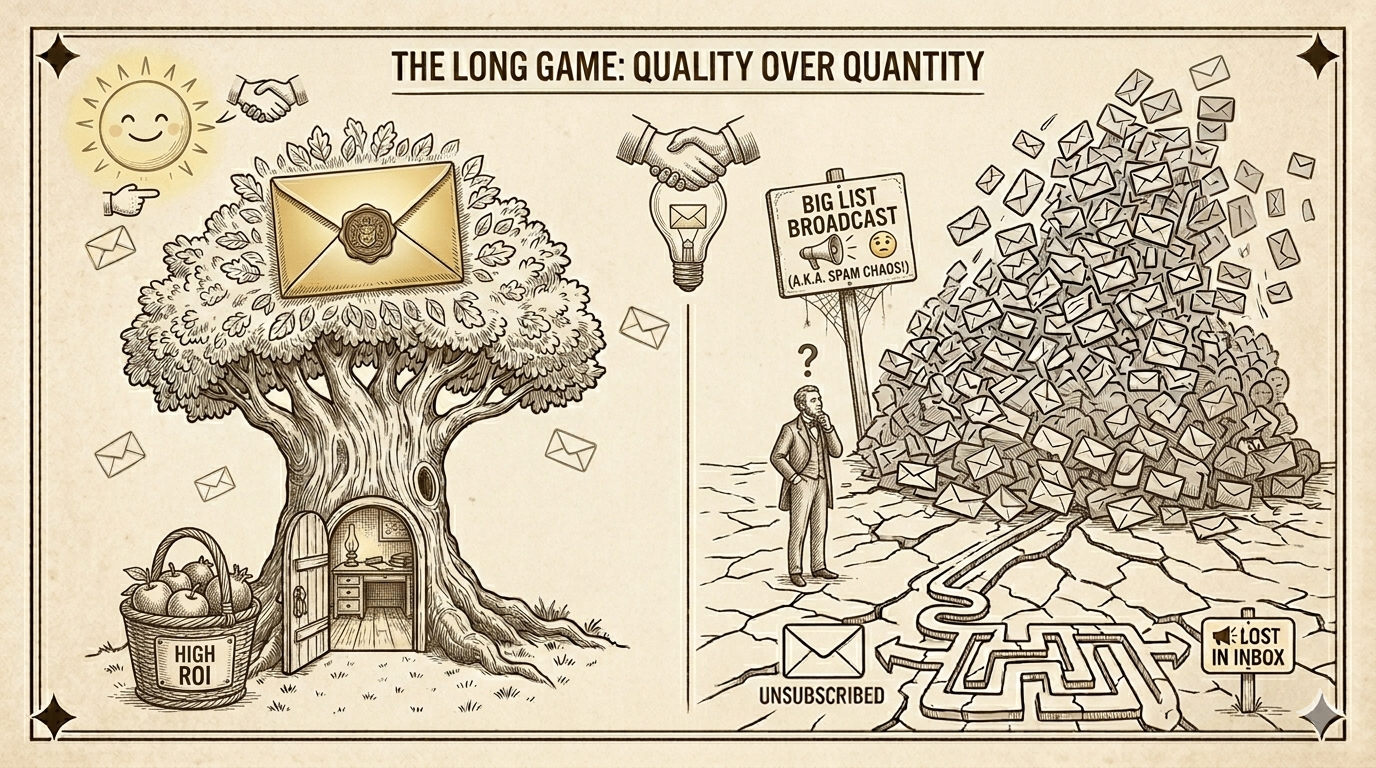
Founders obsess over list size. The bigger, the better, right? More subscribers mean more reach, more eyeballs, and more potential conversions. That logic feels intuitive until you realize that bigger often comes with more noise, lower engagement, and diminished returns.
Email is not a numbers game. It is a signal-to-noise game. Small, engaged lists outperform sprawling, disengaged ones because influence, trust, and conversion compound in concentrated audiences. The long game favors quality over quantity, precision over vanity metrics, and persistence over instant gratification.
Signal-to-Noise Economics
Every subscriber adds both signal and noise. On large lists, the signal of engaged readers is diluted by inactive or indifferent recipients. Metrics like open rates, click-throughs, and engagement percentages often mask this reality.
A highly engaged list of a few hundred can outperform tens of thousands of passive subscribers because the audience is attentive, responsive, and action-oriented. Each issue lands in an inbox where it matters, creating compounding authority.
This is the essence of signal-to-noise economics: fewer, higher-quality connections generate more value than vast, superficial reach. Every email becomes a lever, every reply a data point, and every interaction an opportunity to strengthen trust.
The Power of Small Lists
Small, focused lists offer distinct advantages for founders and operators who want to drive meaningful business outcomes.
Higher engagement rates: Subscribers are genuinely interested in your insights, products, and perspective. Each issue has a higher probability of being read, clicked, or replied to.
Direct feedback loops: Conversations with a small, attentive audience provide actionable insight into product-market fit, messaging, and content strategy. Early adopters become co-creators in your ecosystem.
Compounded trust: Every interaction builds credibility. With a small audience, repeated proximity creates familiarity and authority faster than large, passive lists ever can. This is how newsletters build trust faster than any other channel.
Predictable conversions: Small, engaged lists generate revenue and influence more reliably. Each issue has a measurable, tangible impact.
Flexibility and experimentation: Testing new content formats, offers, or messaging is easier with a responsive, smaller audience. Feedback is immediate, and iteration is rapid.
In short, small lists allow founders to treat email as infrastructure, a predictable, controlled channel for building influence rather than chasing vanity metrics.
Annual revenue per subscriber by niche focus
Revenue includes ads, paid subs, and direct product sales.
The smaller and sharper your niche, the more each subscriber is worth. Wide audiences have wide disengagement.
Sponsor CPM by newsletter type (2026 market rates)
CPM = cost per thousand subscribers charged for a newsletter ad placement.
Why Big Lists Can Mislead
Large subscriber bases feel impressive but are often deceptive:
Engagement averages drop: High numbers hide low engagement. Open rates, click-throughs, and replies diminish proportionally to the list's size.
Noise dilutes impact: Your message competes with unread emails, marketing campaigns, and algorithmic distractions. Understanding deliverability matters more than raw numbers.
Management complexity rises: Segmenting, personalizing, and targeting becomes resource-intensive. Missteps erode trust.
Illusion of authority: Large lists impress on the surface but do not guarantee conversions, influence, or sustained audience loyalty.
Big lists are tempting because they offer the appearance of reach. Small, engaged lists deliver the actual business outcomes that matter: trust, conversion, and leverage. Your newsletter audience matters more than followers.
The Compounding Advantage of Focused Email
Email compounds over time. Each issue is a small deposit in a long-term relationship. Small lists accelerate compounding because each subscriber is more likely to engage, respond, and act.
The effects accumulate:
Trust compounds: Subscribers anticipate, open, and respond to each issue. Repeated exposure strengthens credibility. Build a weekly ritual to accelerate this.
Influence amplifies: Small, active audiences share your content, extend your reach organically, and become brand advocates.
Feedback informs strategy: Direct engagement informs product decisions, messaging, and positioning. A strong engagement playbook is essential.
Revenue becomes predictable: Offers, launches, and partnerships convert more efficiently with an attentive audience. This is how you turn a content channel into a business moat.
The long game of email rewards patience, consistency, and a focus on quality over size. Every issue is an incremental gain in trust and leverage.
Founders Who Play the Long Game
Founders who succeed with email understand that list size is secondary to audience quality. They prioritize:
Consistency: Sending on a predictable schedule, whether weekly or biweekly, creates reliability and habit. Avoid the trap of abandoning your newsletter.
Value-driven content: Insights, actionable lessons, and relevant updates strengthen engagement. Use a story-based framework to keep readers invested.
Direct connection: Encouraging replies and feedback transforms subscribers into collaborators and advocates. Make your newsletter feel human.
Iteration over perfection: Frequent, authentic communication outweighs polished but sporadic content. Don't let perfection kill your consistency.
These founders treat email as a strategic asset, not a vanity metric. Growth and influence follow from sustained, high-quality engagement, not inflated numbers.
Action Steps for Small List Optimization
- Audit your list: Identify your most engaged subscribers. Focus on retaining and nurturing them.
- Segment for relevance: Deliver content tailored to interests, role, or behavior to maximize signal.
- Prioritize reply and engagement metrics: Clicks, opens, and responses are more valuable than subscriber count.
- Publish consistently: Momentum compounds trust and visibility over months, not days. Find the best send times for your audience.
- Leverage insights for business outcomes: Use engagement signals to guide product launches, partnerships, or thought leadership initiatives.
Small, attentive lists are easier to manage, more actionable, and more profitable over time. The long game favors founders who prioritize engagement and trust over raw numbers.
Frequently Asked Questions
Isn't a bigger list always better for growth? Only if engagement scales proportionally. In practice, smaller, highly engaged lists often drive better conversions, trust, and influence.
How do I grow without sacrificing signal-to-noise ratio? Focus on quality over quantity. Acquire subscribers who actively seek your content, and segment to maintain relevance. A landing page that converts helps attract the right audience.
Can a small list really generate revenue or influence? Yes. Highly engaged audiences convert predictably, amplify your message, and provide direct feedback that accelerates strategic outcomes. Learn how to monetize without losing trust.
How do I identify my most valuable subscribers? Look at repeated opens, clicks, replies, and shares. These are your most attentive and influential readers.
How can I turn newsletter engagement into actionable business outcomes? Track patterns in replies and clicks to inform product launches, partnerships, or service offerings. Engage your audience to co-create solutions.
What if I'm worried a small list will limit growth? Focus on compounding trust first. Growth follows naturally when your engaged subscribers become advocates, sharing and amplifying your content. Your first 1,000 subscribers are the most important.
If you want guidance on turning your email list into a high-leverage asset, reach out to Inbox Alchemy today. Our team helps founders build strategic, owned audiences that compound influence, trust, and business results.
Framework Summary
- Signal-to-noise economics: Small lists yield higher-quality signals — engaged subscribers who open, reply, and act are worth more than passive thousands.
- Compounding trust: Every issue deepens familiarity and credibility; small lists accelerate this loop because each subscriber is more likely to engage.
- Predictable conversions: Concentrated, engaged audiences convert more reliably — relationship depth drives revenue more than raw scale.
- The patience principle: Long-game email growth requires resisting vanity metrics (list size) in favor of durable metrics (engagement rate, reply rate, conversions per send).
- Focused growth over fast growth: Acquiring the right subscribers — those who fit your niche — outperforms chasing volume that dilutes your list's commercial signal.
Written by

Investor • Founder • Creator
Ryan Estes is co-founder of Kitcaster, an eight-figure bootstrapped podcast booking agency acquired by Moburst in 2025. He created AI for Founders, a podcast, newsletter, and workshop platform reaching 47,000+ entrepreneurs and CEOs. Based in Denver, Colorado.