What High-Trust Newsletters Do Differently in the First 30 Days
What High-Trust Newsletters Do Differently in the First 30 Days
Early relationship architecture.
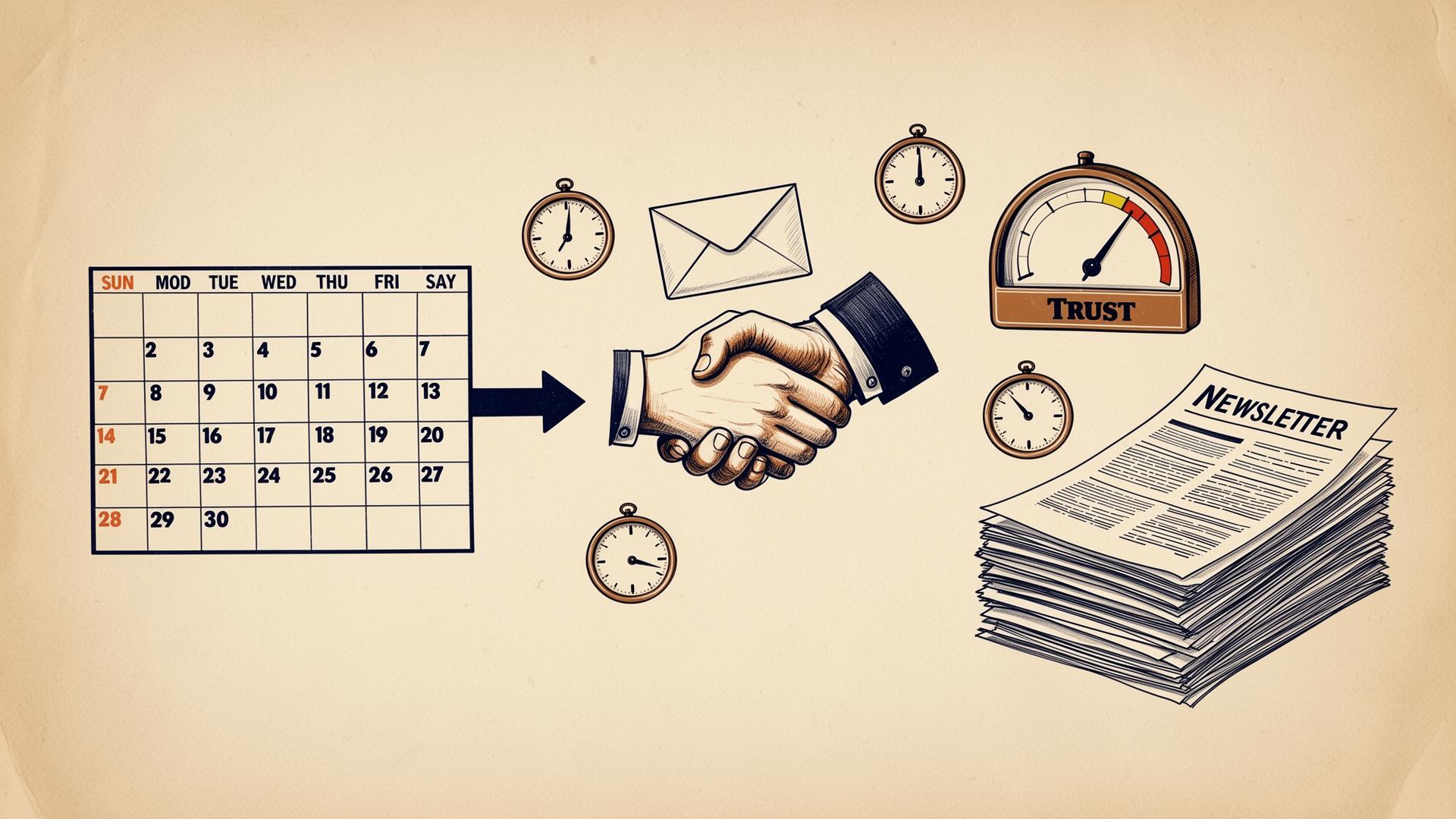
When most founders start a newsletter, they think in terms of numbers: subscribers, open rates, clicks. But the companies that build high-trust newsletters know the first 30 days are not about metrics. They are about laying the architecture for a relationship that lasts years. This is not just email strategy. It is relational engineering. You are not selling a product. You are cultivating credibility, shaping expectations, and demonstrating value every step of the way.
I Engineer Trust Before Asking for Anything
Trust is a signal, not a promise. High-trust newsletters establish it by overdelivering before any transactional request is made. The first three emails you send are your most important. They set the tone for every interaction to come.
Founders often get this wrong by diving straight into announcements, launches, or value propositions. Instead, the first 30 days should focus on:
Clarity: Why does this newsletter exist? Who is it for? What will you consistently deliver?
Consistency: Pick a cadence you can sustain, whether weekly or biweekly, then stick to it. Building a consistent rhythm is one of the most underrated growth strategies.
Value before ask: Give actionable insight or unique perspective before asking subscribers to click, reply, or share.
High-trust newsletters treat each email as a handshake, not a sales pitch. Every line of copy signals competence and empathy. By day 30, subscribers should know exactly what they can expect and that you are the kind of founder whose voice is worth following.
I Map Subscriber Psychology Early
High-trust newsletters are designed around reader perception, not vanity metrics. You are not optimizing for open rate alone. You are optimizing for perceived relevance and utility. That starts with understanding the psychology of new subscribers:
Activation Moments: When someone subscribes, they are primed for validation. Your welcome email should confirm they made the right decision.
Rapid Successes: Give a small, immediate win. For example, an insight they can act on today, a tool recommendation, or a shortcut that saves time.
Expectation Management: If you promise weekly insights, do not email sporadically. If you promise deep dives, do not send surface-level content.
This early architecture creates mental hooks. By day 30, a subscriber's brain should feel like your newsletter is reliably useful, not just occasionally interesting.
Trust-building actions in the first 30 days
Impact score on 90-day retention rate.
The first 30 days are your longest-lasting first impression. Every issue is a trust deposit or a trust withdrawal.
Retention rate at 90 days by onboarding quality
Onboarding quality rated by welcome sequence depth and consistency.
I Use Micro-Personalization Without Overcomplication
High-trust newsletters understand that personalization is relational, not just data-driven. Using the subscriber's name is table stakes. Real trust comes from showing understanding of context, challenges, or industry-specific pain points:
Segment early. Even with 100 subscribers, notice patterns. Founders in AI, SaaS, or consumer apps behave differently.
Reference small signals. Links clicked, content downloaded, or replies sent can guide subtle personalization.
Keep it human. Avoid overly automated tones. High-trust newsletters feel like a conversation, not a broadcast.
By day 30, a subscriber should feel known, even if they never reply. That feeling of being understood separates high-trust newsletters from transactional blasts.
I Craft a Narrative Arc
High-trust newsletters are narrative-first, not news-first. They recognize that stories build memory, and memory builds trust. Even in a technical context, the sequence of emails should have a rhythm:
Week 1: Establish identity, promise value, give a small win.
Week 2: Demonstrate perspective. Your insights differentiate you from generic content.
Week 3: Provide proof through case studies, examples, or transparent thinking.
Week 4: Invite interaction through replies, feedback, or surveys. This is the trust checkpoint.
Constructing an early arc prevents random, scattered emails that feel like noise. Subscribers begin to anticipate your next email. Anticipation itself is a trust multiplier.
I Audit Every Interaction for Friction
High-trust newsletters assume every interaction is a touchpoint in a relationship, not just a metric in a dashboard. This means obsessively auditing for friction:
- Are links and calls-to-action clear?
- Are emails readable on mobile devices?
- Is subscription management easy?
- Are first impressions optimized for clarity and tone?
Even small friction, such as broken links or confusing formatting, can erode trust in the first 30 days. Founders who obsess over these details lay the relational foundation that makes subscribers loyal long-term.
I Make Feedback a Core Mechanism
High-trust newsletters are not monologues. They are two-way conversations. Early feedback loops reinforce that subscriber input matters:
- Invite replies in the first few emails.
- Ask for micro-poll responses, not just clicks.
- Track sentiment and adjust tone accordingly.
This early feedback demonstrates attentiveness and adaptability. Subscribers feel like stakeholders, not passive recipients. This is what separates engaged audiences from passive ones.
Action Blueprint: The First 30 Days of a High-Trust Newsletter
Here is how to operationalize these principles into a repeatable, high-trust sequence:
Day 0, Welcome Email: Confirm the subscription, clearly outline value, and provide an instant, actionable insight.
Day 3 to Day 5: Send a perspective-driven email. Share a unique insight, framework, or story. Avoid pitching anything yet.
Week 2: Offer proof of expertise. Show examples, case studies, or transparent reasoning behind a decision you have made.
Week 3: Personalize micro-level touchpoints. Reference subscriber behavior subtly or highlight content based on inferred interests.
Week 4: Invite interaction. Request a reply, a small survey, or an opinion. Treat every response as gold.
Checklist:
- Are emails clear and mobile-optimized?
- Do subject lines signal value without hype?
- Does each email deliver before asking?
- Are links, downloads, and calls-to-action frictionless?
- Is narrative and perspective consistent week over week?
Following this blueprint turns a first-month newsletter into a high-trust engine rather than a disposable broadcast.
Why the First 30 Days Matter More Than Subscriber Count
Most founders obsess over subscriber counts. High-trust newsletters obsess over first impressions. One hundred subscribers who trust you are exponentially more valuable than 10,000 who ignore you. Early relationship architecture compounds over time:
- Trust increases open rates.
- Trust increases engagement.
- Trust increases shareability.
- Trust creates advocacy. Subscribers become ambassadors.
The early sequence is the infrastructure for every future campaign, launch, and revenue opportunity. Get it right in the first 30 days, and everything that follows is easier.
Take the Leap: Build Trust, Not Just Lists
High-trust newsletters are engineered, not guessed. They blend perspective, clarity, and relational psychology into a sequence designed to create enduring credibility. The first 30 days are your opportunity to prove that your emails are worth a relationship, not just a glance.
If you want to see how a high-trust newsletter can transform your founder brand, peek behind the curtain at Inbox Alchemy. We help founders craft early email experiences that turn subscribers into believers and believers into long-term business outcomes.
Q&A: Early Newsletter Relationships
How often should I email in the first 30 days? Frequency matters less than consistency. Two emails in the first week is fine, then weekly. Avoid erratic timing. Finding the right cadence is essential.
Should I focus more on storytelling or tips? Both. Storytelling builds memory. Tips build utility. Mix them in each email to create a narrative arc that delivers micro-wins.
How do I know if trust is being built? Look beyond opens. Track replies, clicks on actionable content, and survey responses. Early engagement signals relational trust more than vanity metrics.
Reach out to Inbox Alchemy to start building your first 30 days of trust, one email at a time.
Written by

Investor • Founder • Creator
Ryan Estes is co-founder of Kitcaster, an eight-figure bootstrapped podcast booking agency acquired by Moburst in 2025. He created AI for Founders, a podcast, newsletter, and workshop platform reaching 47,000+ entrepreneurs and CEOs. Based in Denver, Colorado.